At first glance, it may seem that they exist simply because they save space.
That is certainly part of the story.
But there may be another reason.
In Japan, eating alone is not usually considered unusual. Many people naturally gravitate toward the kind of seat that matches the experience they are looking for, and a counter seat is often one of those choices.
Quick Summary
- Counter seats help restaurants make good use of limited space.
- Eating alone is widely accepted in Japan.
- Different restaurants use counter seats for different experiences.
- Counter seats create a comfortable distance between people.
- They reflect a culture that values enjoying a meal on your own terms.
Counter Seats Serve Different Purposes
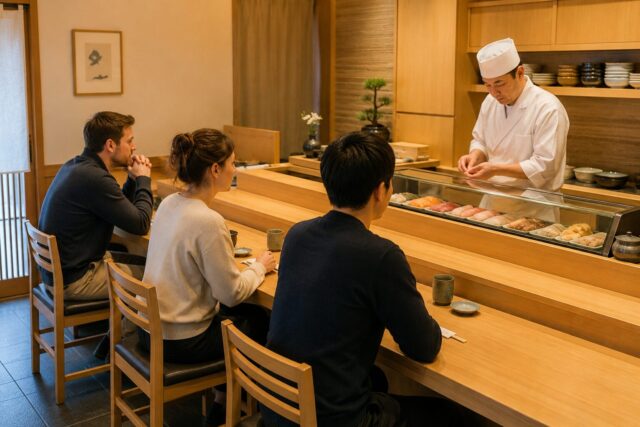
At many sushi restaurants, the counter lets customers enjoy watching the chef's work as part of the dining experience.
Not every counter seat offers the same experience.
At a sushi restaurant or teppanyaki restaurant, sitting at the counter lets customers watch the chef work up close. The preparation itself becomes part of the meal.
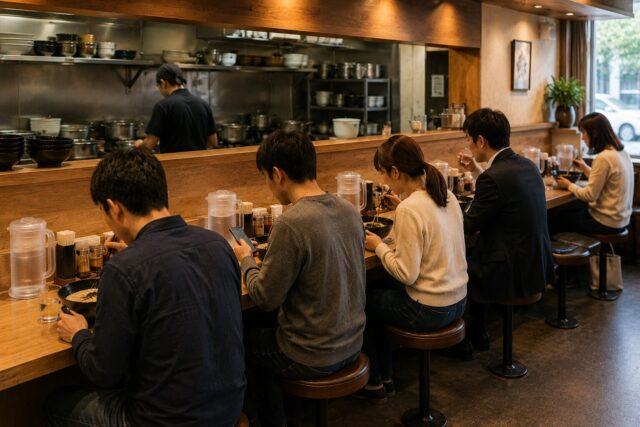
A ramen shop tends to feel different.
Many people are not looking for a performance. They simply want to enjoy a hot bowl of ramen while it is at its best. The counter gives them a space to do exactly that.
An izakaya counter has its own atmosphere entirely.
Some customers sit quietly with a drink, while others might exchange a few words with the owner or even the person sitting nearby.
The setting is the same, but the experience can be quite different.
Eating Alone Is a Normal Part of Everyday Life
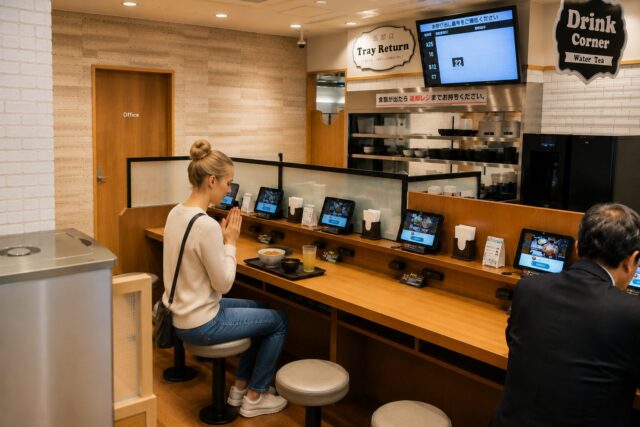
One reason counter seats feel so natural in Japan is that eating alone is simply a normal part of daily life.
People often stop by a restaurant during a lunch break, after work, while shopping, or while traveling.
Dining alone is rarely treated as something lonely or unusual.
For many people, it is simply a chance to enjoy a quiet moment to themselves.
Many restaurants are designed with solo customers in mind, and counter seats make it easy to settle in and eat at your own pace.
This does not mean that Japanese people do not value time with others.
Many people simply appreciate both — shared meals and meals enjoyed alone.
Choosing the Seat That Fits the Moment
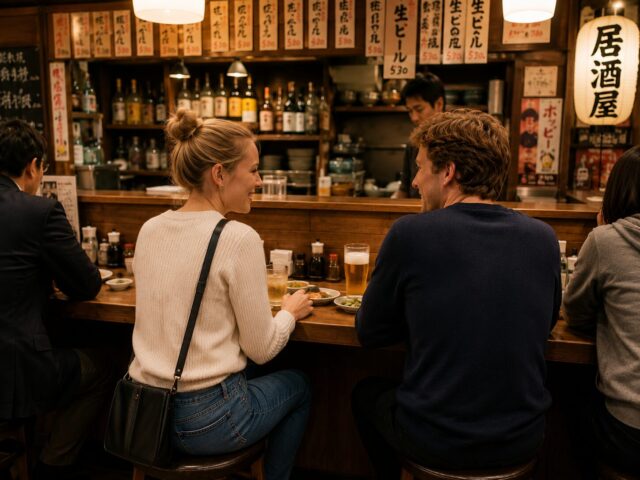
Many Japanese people naturally choose a seat that suits the kind of meal they are after.
Friends who want to talk while eating may gravitate toward a table.
Someone who wants to quietly work through a bowl of ramen may find the counter more comfortable.
Couples sometimes choose to sit side by side at a counter, looking out in the same direction rather than facing each other.
The choice is often less about how many people there are and more about how they want to spend that particular meal.
A Comfortable Distance
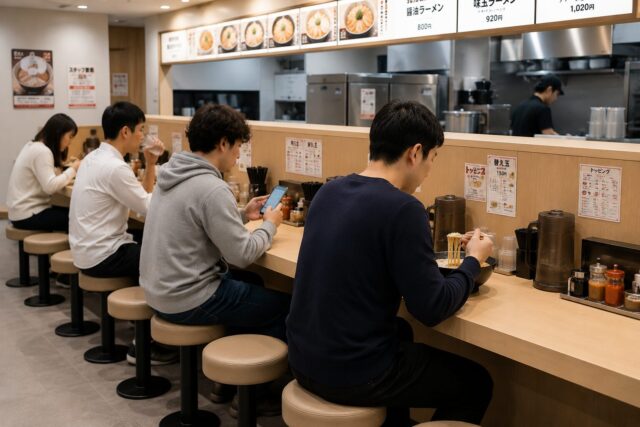
One of the more interesting features of counter seats is the kind of distance they create between people.
Customers may be sitting close together, but they are usually facing the same direction.
At a table, sitting face to face naturally invites conversation. A long silence can start to feel awkward.
A counter works differently.
People can focus on their own meal without feeling any pressure to talk. At the same time, they are not completely cut off from the people around them.
If someone wants a quiet moment, they can have it.
If a brief conversation happens naturally, that is perfectly fine too.
The counter lets people decide for themselves how much interaction they want.
Perhaps that flexibility is one reason it feels so comfortable to so many Japanese people.
More Than Just Saving Space
It would be easy to explain counter seats as nothing more than an efficient use of limited space.
In reality, they also reflect the way many Japanese restaurants are actually used.
Some counters bring customers closer to the chef.
Others give people a space to focus entirely on the food.
Others simply provide a comfortable spot for a quiet drink and the occasional conversation.
Many Japanese customers naturally read the atmosphere of a restaurant and choose the seat that feels right for that moment.
Perhaps that is why counter seats feel so unremarkable in Japan.
They are not just seats for people dining alone.
They are one of the ways people can enjoy a meal entirely on their own terms.
Author's Note
As a Japanese person, I have never thought of counter seats as being only for people eating alone.
If I want to talk with friends over ramen, I would probably choose a table.
But if I want to focus on the bowl itself, the counter somehow feels like the right place.
The person next to me may be sitting just an arm's length away, but that is precisely why we quietly give each other space.
I also appreciate having the choice.
Sometimes I want to share a meal with family or friends.
Sometimes I just want to eat quietly without thinking about anyone else.
Neither feels strange to me.
Looking back, I think one reason counter seats feel so natural is that they let people share the same space while still keeping their own time.
Perhaps that quiet balance is something many Japanese people value without ever putting it into words.
FAQ
Why are counter seats so common in Japan?
They help restaurants use space efficiently, but they also suit the way many people naturally prefer to enjoy a meal.
Is it normal to eat alone in Japan?
Yes. Eating alone is widely accepted and is generally seen as a normal part of everyday life.
Are counter seats only for solo diners?
No. Couples and small groups use them too, depending on the kind of atmosphere they are looking for.
Why do many ramen shops have counter seats?
Many customers want to focus on the bowl in front of them, and counter seats create a comfortable, personal space for that.
Do people talk to strangers at the counter?
Not usually. In some smaller restaurants and izakaya, however, brief conversations can happen quite naturally.
Related Reading on YUNOMI
- Japanese Restaurant & Hospitality Culture: Why Dining in Japan Feels So Different
- Why Do Japanese Restaurants Often Have Small Tables?
- Why Do Japanese Restaurants Feel So Quiet?
- Why Are So Many Japanese Restaurants Specialized in One Dish?
- Why Do Japanese People Line Up for Restaurants?

