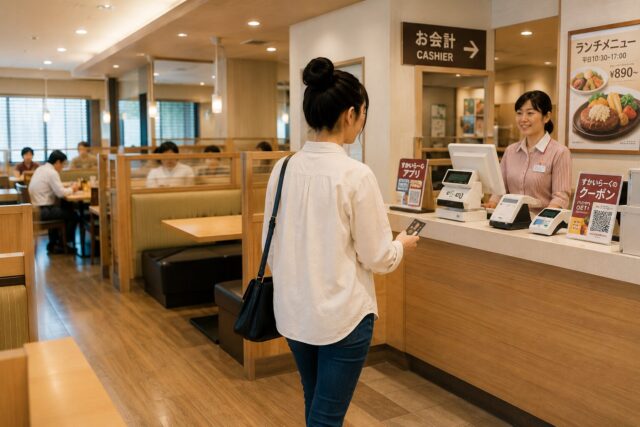
At the same time, modern restaurant systems in Japan are changing rapidly. Some places still use cash and handwritten bills, while others rely on tablets, QR ordering, self-checkout machines, and contactless payment systems.
Understanding the general flow helps many visitors feel much more comfortable when dining out — even though there is no single system used everywhere.
Early bill placement, centralized registers, self-checkout systems, and minimal table interruption all reflect this broader hospitality philosophy.
Step 1: The Bill Arrives at the Table
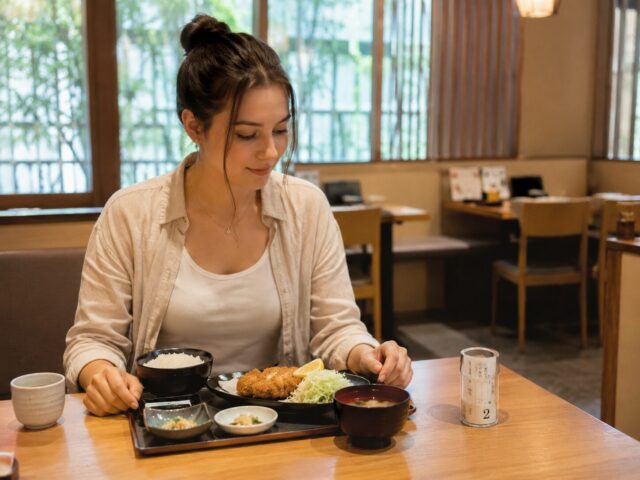
Many Japanese restaurants place the bill on the table before customers ask for it.
This is not a signal to hurry — it simply allows customers to leave smoothly whenever they are ready.
During the meal, the bill slip also functions as a shared record of the current order for both customers and staff.
Customers may glance at it to confirm what has already been ordered, especially after adding dishes or drinks partway through the meal.
It can also help catch misunderstandings or accidental duplicate orders before payment, helping the meal continue smoothly without unnecessary interruption.
This helps reduce small misunderstandings on both sides and avoids repeated confirmation during the meal.
Rather than pressuring customers to leave quickly, the system reduces unnecessary interaction between customers and staff while still keeping the dining experience organized.
In many ways, this reflects a broader Japanese preference for smooth flow, minimal interruption, and low-pressure communication.
Step 2: Finish the Meal and Pick Up the Bill
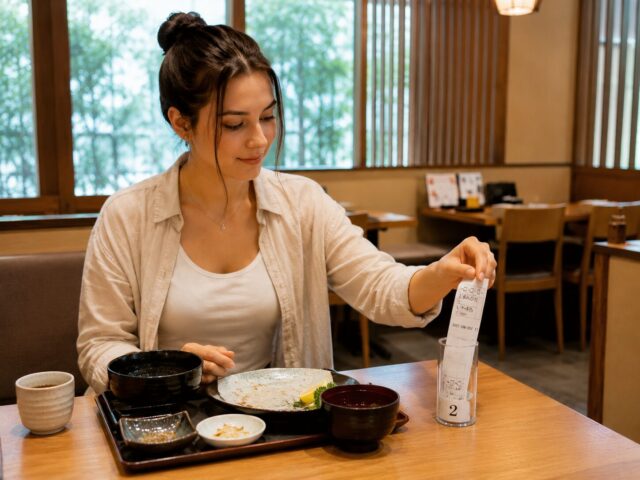
Once customers finish eating, the next step is simply to pick up the bill slip from the table.
In many Japanese restaurants, customers are expected to bring the slip with them when paying.
The slip often contains a barcode, table number, or other information needed at the register or self-checkout machine.
Many foreign visitors initially hesitate, unsure whether they are allowed to take the bill from the table.
In Japan, however, this is completely normal and expected.
In some smaller restaurants or izakaya, there may be no physical bill slip on the table at all.
In these cases, staff track orders internally and customers simply tell the cashier their table number or let a staff member know they are ready to pay.
Step 3: Walk to the Register Near the Exit
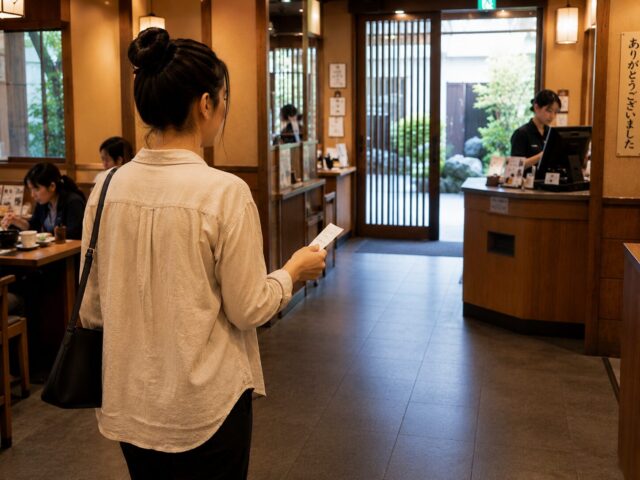
In many Japanese restaurants, the payment counter is located near the entrance or exit.
After finishing the meal, customers simply stand up and walk to the register.
There is usually no need to wait for staff, request the check, or signal in any special way.
For many foreign visitors, this expectation that customers move to the register entirely on their own can feel surprisingly unfamiliar at first.
This centralized payment system allows restaurants to keep table interactions simpler, avoid interrupting meals, and manage customer flow more smoothly.
In many Western restaurants, servers handle payment individually at the table.
In Japan, service is more often managed collectively by the staff as a whole, making a central register a natural fit for the overall dining flow.
Some modern restaurants also have self-checkout machines near the register area.
If you are unsure where to pay, it is perfectly fine to get a staff member's attention and say "Okaikei onegaishimasu" ("The bill, please") or simply "Sumimasen."
Staff will immediately point you in the right direction.
Step 4: Pay — Tipping and Splitting the Bill
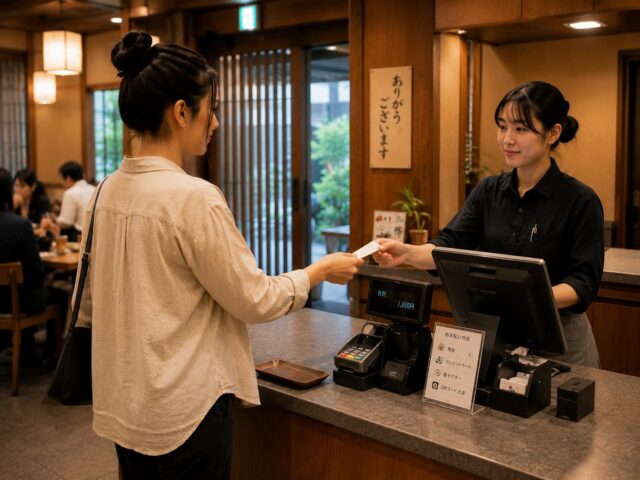
Tipping: Tipping is not part of restaurant culture in Japan.
The listed price already covers food, service, and hospitality.
Because Japanese payment systems are built around fast, standardized checkout at a central register, there is generally no established way for staff to handle extra cash left as a tip.
Many staff members may genuinely appreciate the intention, but could still feel unsure about how to process it within the restaurant's system.
Unlike some Western countries where tipping is built directly into the tableside payment process, Japanese restaurants are structured around short, efficient payment flow at the register.
Verbal thanks — or simply saying "Gochisousama deshita" while leaving — is usually considered the more natural way to express appreciation.
Splitting the Bill: Many restaurants allow separate payments, especially larger establishments and chain restaurants, though the process varies.
In some places, customers simply tell the cashier they would like to pay separately.
In others, the group divides the total among themselves after one person pays first.
Mobile payment apps such as PayPay have also made splitting costs much more convenient.
During busy periods — particularly at lunch — it helps to be mindful that staff are trying to keep the register queue moving efficiently.
Modern Restaurants and Self-Checkout
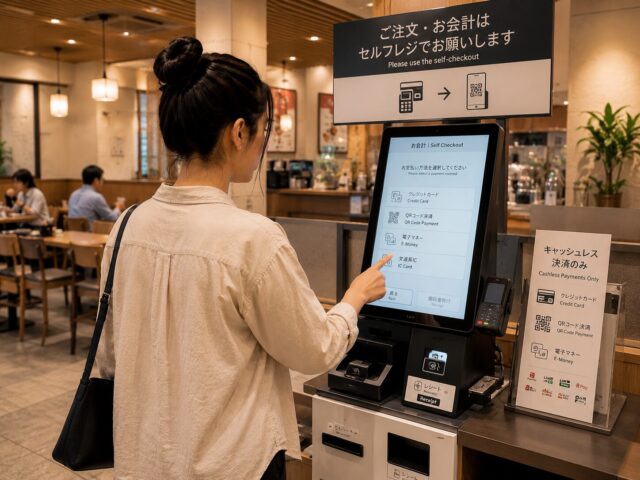
In recent years, many Japanese restaurants have introduced tablet ordering, QR-code menus, self-checkout machines, cashless payment terminals, and mobile payment apps — particularly in chain and family restaurants.
Part of this shift accelerated during and after the COVID-19 pandemic, driven by labor shortages, rising costs, and growing demand for contactless service.
Today, some restaurants allow customers to complete the entire dining experience with very little direct staff interaction.
Contactless credit cards and smartphone apps have also made the payment step itself faster and simpler.
Even so, many Japanese restaurants continue to combine these systems with traditional hospitality and personal attentiveness.
It is also worth noting that some smaller or older establishments still accept cash only.
For this reason, carrying some cash remains useful when dining out in Japan.
There Is No Single "Perfect" System
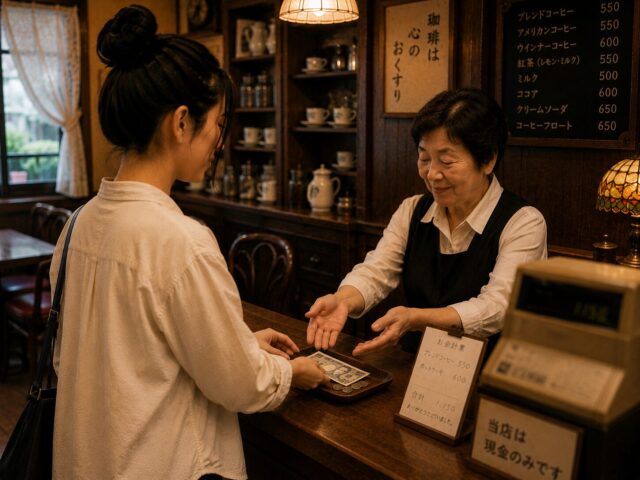
One reason restaurant payment in Japan can feel confusing is that many different styles now coexist.
Some restaurants still use handwritten bills and traditional cash registers, while others rely entirely on touch panels, QR codes, and self-checkout machines.
Even Japanese customers occasionally pause to figure out where the register is or how an unfamiliar payment system works.
At the same time, I still occasionally find myself holding a bill slip and quietly looking around for the register in an unfamiliar restaurant.
Because restaurant technology continues to evolve quickly, the experience may even differ the next time you visit the same place.
Rather than following one national standard, modern Japanese restaurants tend to share a common goal: making the payment experience smooth, quiet, and low-stress.
Payment as Part of Japanese Hospitality Culture
At first glance, Japanese restaurant payment systems can seem highly procedural.
In practice, however, they are designed to reduce friction for both customers and staff — balancing efficiency, calm atmosphere, and minimal interruption throughout the dining experience.
In this sense, the payment process is not separate from Japanese hospitality.
It is simply the final part of a dining experience designed to feel organized and low-pressure from beginning to end.
FAQ
How do you usually pay at restaurants in Japan?
In most restaurants, customers take the bill slip to a register near the entrance and pay before leaving.
Staff interaction during payment is generally minimal.
Why do Japanese restaurants bring the bill early?
The bill is placed on the table so customers can leave smoothly whenever they are ready.
It also helps both sides keep track of the current order during the meal.
Do you pay at the table in Japan?
In most cases, no.
Payment typically happens at a central register rather than tableside.
Is tipping required in Japan?
No.
Tipping is not expected and can sometimes create confusion, as many restaurants have no established system for handling it.
Can restaurants in Japan split the bill?
Many can, especially larger restaurants and chains, though the process varies.
Mobile payment apps have made splitting costs easier in recent years.
Do Japanese restaurants accept credit cards?
Many now accept credit cards, contactless payment, and smartphone apps, but some smaller traditional establishments still accept cash only.
Why do Japanese restaurants use centralized registers?
Centralized payment reduces table interruption, improves efficiency, and allows smoother customer flow.
This fits naturally into Japan's broader service style.
Do Japanese people also feel confused by modern systems sometimes?
Yes.
Even Japanese customers occasionally need a moment to understand an unfamiliar payment setup, since layouts and technology differ considerably from restaurant to restaurant.
Related Reading on YUNOMI
- Japanese Restaurant & Hospitality Culture: Why Dining in Japan Feels So Different
- Why Do Japanese Restaurants Bring the Bill Before You Ask?
- Why Do Japanese Restaurants Have Call Buttons on the Table?
- Why Don’t Japanese Restaurants Expect Tips?
- Why Do Japanese People Say “Gochisousama” After Eating?

