For travelers from countries where restaurants typically offer large menus with many different options, this can feel surprisingly restrictive.
Why would a restaurant intentionally limit what it serves?
The answer reveals something important about Japanese attitudes toward expertise, craftsmanship, and the pursuit of continuous improvement.
In Japan, fewer choices do not necessarily mean a weaker restaurant.
In many cases, a small menu is not a sign of limitation. It is a sign that someone has spent years trying to perfect one thing.
Specialization allows restaurants to refine their techniques, ingredients, and consistency over time.
Many Japanese customers see a narrow menu as a sign of expertise rather than a limitation.
This reflects a broader cultural tendency to value refinement and mastery over variety.
Why Are Specialized Restaurants So Common in Japan?
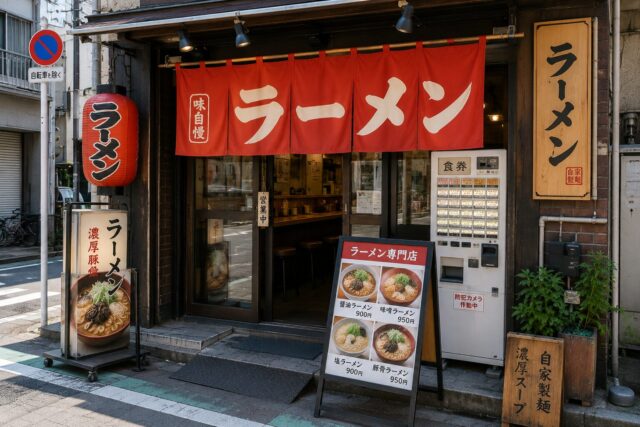
Imagine coming across a restaurant with a window display full of delicious-looking ramen.
You step inside, sit down, and open the menu.
There is no pasta.
There are no burgers.
There may not even be rice dishes.
Instead, nearly every item on the menu is some variation of ramen.
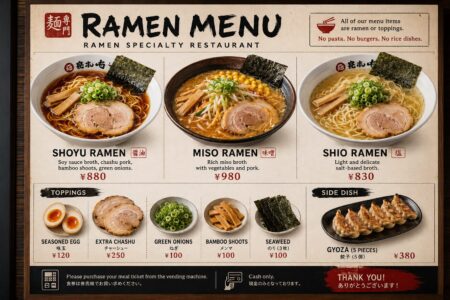
A simplified English menu illustrating how many Japanese ramen specialty restaurants focus almost entirely on different styles of ramen rather than unrelated dishes.
For many first-time visitors, this comes as a surprise.
Yet in Japan, highly specialized restaurants are everywhere.
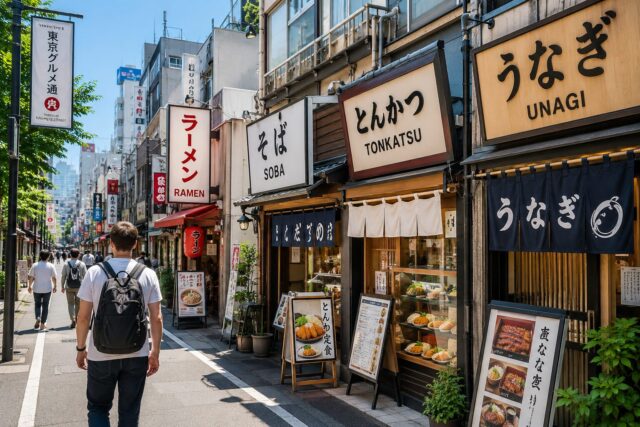
A tonkatsu restaurant is expected to serve tonkatsu. An unagi restaurant focuses on eel. A soba restaurant specializes in soba.
For many Japanese customers, the restaurant name itself already explains what kind of meal to expect.
Rather than feeling limited by this, many people see specialization as part of the restaurant's appeal.
Why Did Specialization Become So Common in Japan?
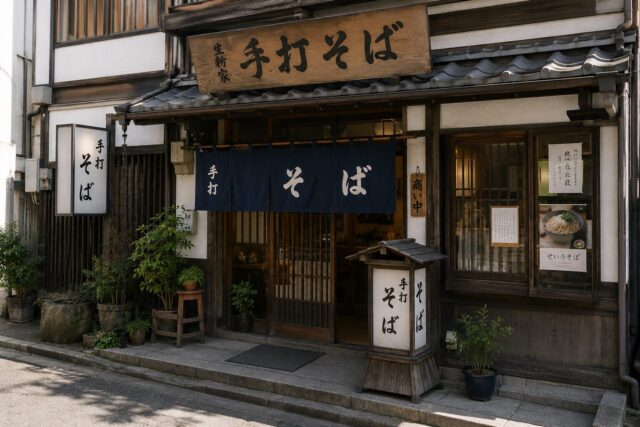
Specialized restaurants did not suddenly appear in modern Japan.
Their roots can be traced back to the Edo period (1603–1868), when rapidly growing cities created demand for quick, affordable meals.
Many food stalls and small shops focused on a single specialty — soba, tempura, sushi, or grilled eel.
This made practical sense.
Customers knew exactly what they were getting, while shop owners could concentrate on preparing the same food efficiently and consistently.
Some historians even describe Edo's soba stalls as an early form of fast food — busy city residents could grab a quick bowl before heading back to work.
Over time, this model became deeply embedded in Japanese food culture.
Even as restaurants modernized, the idea that a business could build its entire reputation around a single specialty remained remarkably strong.
Today, the same pattern can still be seen across Japan.
Ramen shops, curry restaurants, sushi counters, soba specialists, and tonkatsu restaurants all continue to build their identities around a single category of food.
Mastery, Competition, and Trust
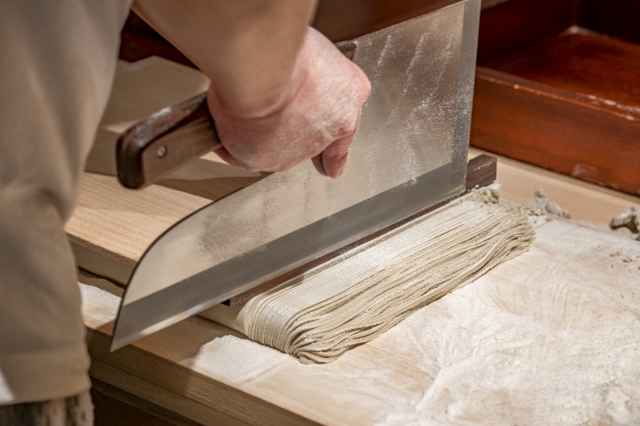
Many Japanese food specialists spend years refining a single technique through constant repetition and practice.
One reason specialized restaurants remain so common in Japan is a deep cultural appreciation for mastery.
Rather than becoming reasonably good at many different things, many Japanese craftsmen prefer to focus deeply on a single skill and refine it over time.
The Shokunin Mindset
This mindset is often associated with the concept of shokunin.
The word is usually translated as "craftsman," but it implies something more than simply having a trade.
A shokunin is someone who dedicates themselves to continuous improvement and takes genuine pride in refining a particular skill over the course of many years.
The term applies not only to traditional crafts, but also to cooking, food preparation, and many other specialized fields.
A sushi chef may spend years perfecting rice preparation and knife technique.
A ramen chef may spend decades adjusting broth recipes, experimenting with ingredients, and refining cooking methods.
A tempura specialist may devote countless hours to mastering batter consistency, oil temperature, timing, and texture.
To outside observers, serving only ramen or only tempura can seem limiting.
To many Japanese craftsmen, however, narrowing the focus creates more room for improvement.
Competition Between Specialists
This drive becomes even more meaningful because specialized restaurants typically compete directly against other specialists.
A ramen shop is measured against other ramen shops.
A soba restaurant competes with other soba specialists.
A tonkatsu restaurant is judged against other tonkatsu restaurants.
When the competition is that specific, small differences start to matter enormously.
Broth, noodles, frying oil, rice quality, texture, aroma, timing, and presentation can all become points of comparison.
As a result, restaurants are constantly searching for ways to improve.
Why Customers Trust Specialized Restaurants
This helps explain why so many Japanese customers trust specialized restaurants.
There is often an unspoken assumption at work:
"If this restaurant only serves one thing, it had better be very good at that one thing."
In this way, specialization raises expectations rather than lowering them.
A restaurant that chooses to focus on a single dish is expected to deliver something above average.
For many Japanese diners, a narrow menu inspires confidence precisely because it suggests the restaurant has spent years honing its craft.
Pro Tip: Look at the Sign First
One easy way to identify specialized restaurants in Japan is to look at the sign or noren (the traditional fabric curtain hung at the entrance).
If a restaurant prominently displays a word like "ramen," "soba," "unagi," or "tonkatsu," there is a good chance it focuses primarily on that dish.
In many cases, the dish itself is the restaurant's identity.
Choosing What to Eat Before Choosing Where to Eat
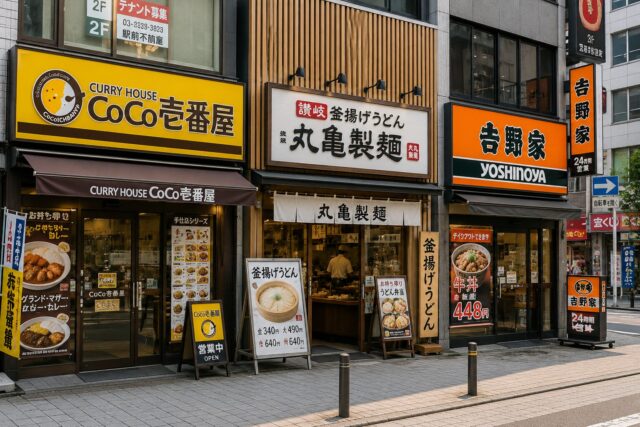
At first glance, specialized restaurants seem to reduce customer choice.
In reality, they often just move the choice to a different moment.
Rather than choosing between dozens of unrelated dishes at a single restaurant, customers choose between restaurants that each excel at something different.
This shift changes how many Japanese people approach dining altogether.
In many countries, the process starts with choosing a restaurant and then deciding what to order.
In Japan, it is often the other way around.
Many people begin by deciding what they feel like eating.
Once they know they want ramen, soba, tonkatsu, curry, sushi, or tempura, they look for a restaurant that specializes in that dish.
As a result, specialization tends to feel natural rather than restrictive.
For many people, the question is not:
"Which restaurant should I go to?"
Instead, it is:
"What do I feel like eating today?"
In some cultures, variety itself is seen as a form of value.
In Japan, value is more often found in refinement.
That difference goes a long way toward explaining why specialized restaurants continue to thrive.
Not Every Japanese Restaurant Is Specialized
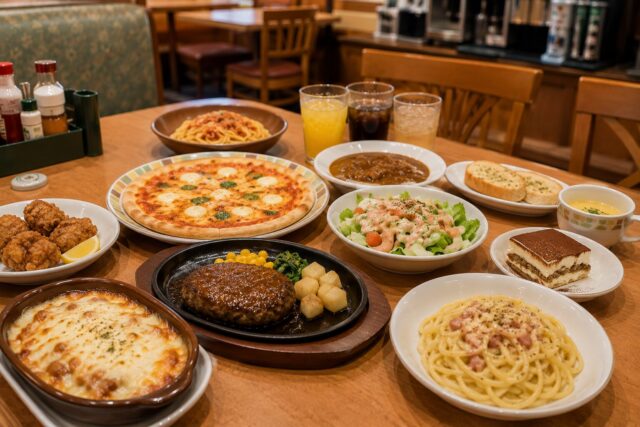
Of course, not all restaurants in Japan follow this model.
Family restaurants often serve a wide variety of dishes, while izakaya pubs typically offer extensive menus designed for sharing over drinks.
Large chain restaurants may also provide broad menus intended to appeal to families and groups with varying tastes.
These restaurants play an important role in Japanese dining culture.
Their goal is often convenience, flexibility, and broad appeal — not mastery of a single dish.
In that sense, specialized restaurants and family restaurants serve quite different purposes.
One focuses on variety.
The other focuses on depth.
Neither is inherently better than the other.
Many Japanese diners, however, turn to specialized restaurants when they want to experience a particular dish at its very best.
It is also worth noting that specialization does not necessarily mean expensive.
Many ramen shops, soba restaurants, curry shops, and tonkatsu restaurants remain affordable, everyday dining options — even after years of quietly refining their craft.
More Than Just a Restaurant Style
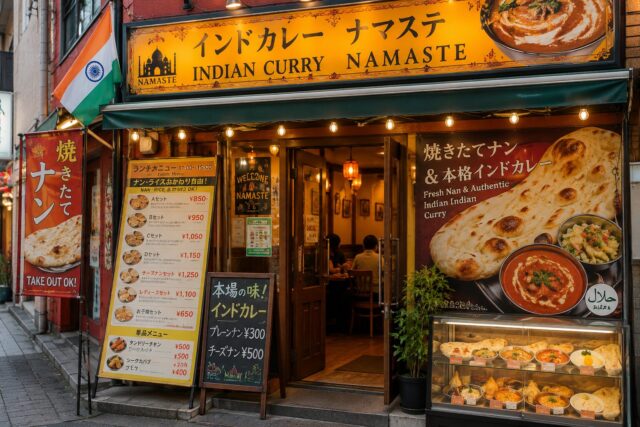
Even cuisines that originated outside Japan, such as Indian curry, are often served in highly specialized restaurants, reflecting how deeply specialization has become part of Japanese dining culture.
Specialized restaurants are not unique to Japan.
But the idea has taken particularly strong root there because it aligns with several deeply held cultural values: craftsmanship, consistency, expertise, and the drive for continuous improvement.
What appears at first to be a narrow menu is often the result of an entirely different way of thinking about quality.
Rather than asking, "How many things can we offer?"
Many specialized restaurants ask a different question:
"How good can we make this one thing?"
That question has shaped countless ramen shops, soba restaurants, sushi counters, tonkatsu specialists, curry shops, and tempura restaurants across Japan.
For many owners, specialization is not about limiting possibilities.
It is about creating the best possible version of a dish they believe in.
Once that mindset becomes familiar, a small menu no longer looks disappointing.
It begins to look like a promise.
Frequently Asked Questions
Why do so many Japanese restaurants specialize in one dish?
Specialization allows restaurants to focus on refining techniques, ingredients, and consistency. This tradition has deep historical roots and remains a defining feature of Japanese food culture today.
Are specialized restaurants always expensive?
No. Many ramen shops, soba restaurants, curry restaurants, and tonkatsu restaurants are affordable everyday dining options despite spending years refining their craft.
What does shokunin mean?
Shokunin is often translated as "craftsman," but it usually implies dedication, pride, responsibility, and a lifelong commitment to improving a particular skill.
Do all Japanese restaurants specialize in one thing?
No. Family restaurants, izakaya pubs, and many chain restaurants offer extensive menus with a wide variety of dishes.
Why do Japanese customers trust specialized restaurants?
Many people believe that a restaurant focusing on one dish has spent years refining it. A narrow menu often suggests expertise and experience rather than limitation.
Why are everyday meals in Japan often considered high quality?
One reason is that many specialized restaurants compete directly against other specialists serving the same dish, encouraging constant improvement and refinement.

