
Japanese Valentine’s Day looks familiar at first—but it works very differently from Valentine’s Day in most other countries.
On February 14 in Japan, women give chocolate to men. Not flowers. Not cards. And not usually as a couple’s celebration.
Most Japanese people do not associate the day with religion or history. Few know who Saint Valentine was, and even fewer think of Valentine’s Day as a Christian holiday.
In Japan, it is simply understood as “Valentine’s Day”—a yearly event shaped by chocolate, timing, and shared social expectations.
Quick Summary: Japanese Valentine’s Day is a modern cultural custom where women often give chocolate to men on February 14.
While it began as a commercial event, it survived because the timing fit Japan’s school calendar and because chocolate worked as a clear social signal—first as a confession tool for students, and later as a practical expression of gratitude and connection among adults.
What Makes Japanese Valentine’s Day Different?

In Japan, chocolate is the central symbol of Valentine’s Day.
In many Western countries, Valentine’s Day centers on couples, romance, and mutual exchange.
In Japan, the structure is different. The main action is giving chocolate, and it often starts as a one-sided gesture from women. This alone makes Japanese Valentine’s Day feel unusual to many visitors.
The difference is not only about who gives what, but also about when the day takes place—and how that timing fits Japanese life.
A Custom, Not a Religious Holiday

For most Japanese people, Valentine’s Day is not experienced as a religious event. Its Christian origin rarely appears in everyday conversation.
The custom spread in Japan after World War II through chocolate marketing. Over time, it stopped feeling like an imported tradition and became something distinctly Japanese—an annual moment that people recognize without needing to explain.
In Japan, many customs survive not because their original meaning is remembered, but because they fit naturally into daily life. Valentine’s Day is a clear example of this.
Chocolate as a Social Signal
In Japan, chocolate is more than a sweet—it is a signal.
Because communication often relies on context rather than direct statements, expressing feelings can feel risky. People worry about misunderstanding, rejection, or creating awkward situations.
Valentine’s Day reduces that risk. On this one day, giving chocolate is understood as meaningful. The action itself carries a message, and both sides share the same frame of reference.
Honmei and Giri: Two Very Different Meanings

In Japan, the same chocolate can mean romance or simple appreciation.
One of the most important things to understand about Japanese Valentine’s Day is that not all chocolate means the same thing.
Honmei Chocolate

Honmei chocolate is given to someone you truly like. It functions as a clear expression of romantic interest.
Because the timing and meaning are shared, this gesture feels less ambiguous than a confession on an ordinary day.
Giri Chocolate

Giri chocolate is given out of courtesy or appreciation—to classmates, coworkers, or acquaintances. It does not express romantic feelings.
This distinction allows the same action—giving chocolate—to carry different meanings depending on context, something Japanese culture is particularly comfortable with.
Why February 14 Was the Perfect Timing

February 14 comes just before major school-year endings in Japan.
The reason Japanese Valentine’s Day survived has much to do with its timing.
In Japan, March is a month of endings. Graduation ceremonies, the end of the school year, and class changes arrive together. For students, it is a season filled with uncertainty.
There is not much time left. Someone you see every day may soon be gone. Waiting “a little longer” can easily mean missing the chance entirely.
Valentine’s Day arrives just before that turning point. It comes late enough in the year for feelings to have grown, but early enough that the consequences—good or bad—do not last long.

If a confession fails, there is little time left for awkwardness. If it succeeds, it can lead naturally into April, the season of new starts in Japan.
This is why Valentine’s Day as a “confession event” is mostly associated with students rather than adults.
Giri Chocolate Among Students: Not Romance, but a Special Kind of Like
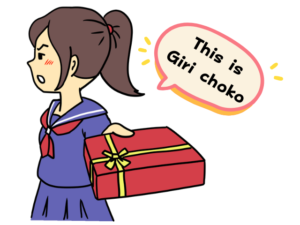
Among students, giri chocolate often comes with an explicit message to avoid misunderstanding.
Among students, giri chocolate has a slightly different nuance.
It is often given to a male friend who is clearly important—more than just another classmate, but not a romantic interest. In other words, someone you like, but not in the sense of love.
This is why the message is often made very explicit. Because the relationship is close, the giver can say it directly: “This is giri. Don’t get the wrong idea.”
That clarity is possible precisely because they are friends. The honesty protects the relationship.
For the boy receiving it, the effect can still be real. Even without romance, being singled out—placed above “just classmates”—is enough to lift spirits and deepen loyalty.
Logic has little to do with it. Many boys understand the meaning perfectly—and still feel encouraged. We are not complicated creatures.
After Graduation: Gratitude, Not Obligation

Once people enter adult life, Japanese Valentine’s Day often changes role.
Among adults, giri chocolate is better understood as an expression of gratitude, not etiquette or obligation.
It sits somewhere between formal seasonal gifts like ochūgen and casual souvenirs—less rigid than traditional gift-giving, but more meaningful than a random snack.
In professional settings, especially in sales or client-facing roles, Valentine’s Day can offer a natural moment to express appreciation. Receiving chocolate tends to create a small positive emotional response and an easy opening for conversation.
This practical usefulness helped Valentine’s Day remain relevant even outside school life.
The Decline of Mandatory Giri Chocolate
For a long time, workplace giri chocolate was common. But in recent years, that “mandatory” phase has largely faded.
Instead, modern trends emphasize:
- Tomo-choco: chocolate exchanged between friends
- Jibun-choco: chocolate bought as a seasonal treat for oneself
- Fami-choco: chocolate given to family members
Valentine’s Day is not disappearing—it is adapting.
How Is It Different from Western Valentine’s Day?

In many Western countries, Valentine’s Day centers on couples and mutual exchange.
In Japan, it traditionally starts with women giving chocolate, followed by a response on White Day in March.
This two-step structure makes the Japanese version feel more ritualized and less spontaneous.
Why Japan Celebrates Valentine’s Day Differently

In adult life, Valentine’s chocolate often expresses appreciation rather than romance.
Japanese Valentine’s Day began as a commercial event, but it survived because it fit real moments in people’s lives.
For students, February 14 aligned perfectly with the emotional tension of the school year’s end. For adults, chocolate offered a socially safe way to express gratitude and connection.
That combination of timing and usefulness is why Japan celebrates Valentine’s Day differently—and why it continues to feel natural today.
FAQ: Japanese Valentine’s Day

Do Japanese women have to give chocolate on Valentine’s Day?
No. There is no official rule. In some environments, there may be unspoken expectations, but participation depends on personal choice.
Does receiving chocolate mean romantic interest?
Not always. Only honmei chocolate clearly expresses romantic feelings. Giri chocolate does not—and this is often stated directly.
Is giri chocolate always meaningless?
No. While giri chocolate does not express romantic love, it is not meaningless. Among students, it can signal a valued friendship. Among adults, it often expresses gratitude or appreciation. The meaning lies in the relationship, not the romance.
Is Valentine’s Day mainly for students in Japan?
It is strongly associated with students because of its timing before major school-year changes, but adults may still use the day as a moment for courtesy or connection.
Is giri chocolate still common at work?
Less than before. Mandatory workplace giri chocolate has declined, with more people choosing friend chocolate, self-gifting, or opting out.
Do Japanese people know the original meaning of Valentine’s Day?
Most do not—and that is normal. In Japan, Valentine’s Day is understood as a cultural event rather than a religious one.
Author’s Note:
As a Japanese man, Valentine’s Day was never about history or religion for me. As a student, it was simply “that day”—the one when you quietly hoped something might happen.
I also remember being given giri chocolate with a very clear message: “This is giri choco.”
That phrasing didn’t completely shut the door on romance—it simply placed the moment one step below honmei.
And that ambiguity was enough. It allowed the imagination to wander, even if just a little.
That mix of timing, honesty, and small emotional rewards is exactly what makes Japanese Valentine’s Day feel uniquely Japanese.

