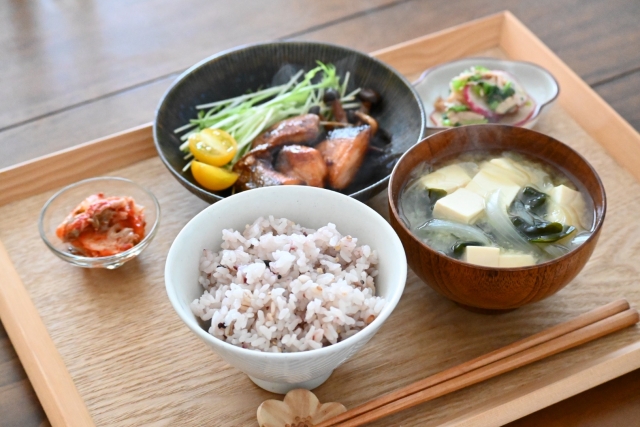
- steamed rice
- miso soup
- grilled fish, meat, tofu, or another main dish
- one or two small vegetable dishes
- pickles
Not every teishoku is a literal example of ichiju sansai. Some have fewer dishes, while others have more. But many follow the same basic logic: rice forms the foundation, soup adds warmth, and several dishes contribute different flavors, ingredients, and textures.
Ichiju sansai is therefore useful for understanding how a Japanese meal is organized.
It is not a strict rule that every household follows every day.
It is a basic model.
Quick Summary
Ichiju sansai means:
- one soup
- three dishes
A typical meal includes:
- rice
- one bowl of soup
- one main dish
- two smaller side dishes
- pickles, usually served separately
Rice is not counted as one of the three dishes. It is treated as the staple and foundation of the meal.
The three dishes are usually understood as one main dish and two side dishes.
Ichiju sansai began as a way of organizing a meal rather than as a modern nutritional plan. Today, it is also valued as a practical guide to variety and balance.
It remains an ideal structure, not an everyday requirement.
What Does Ichiju Sansai Mean?
The word ichiju means “one soup.”
The word sansai means “three dishes.”
In its most familiar form, the meal includes:
- rice
- one soup
- one main dish
- two side dishes
The main dish is called shusai. It often contains fish, meat, eggs, tofu, or another food with a stronger flavor or more substantial role.
The smaller dishes are called fukusai. They may include vegetables, seaweed, beans, mushrooms, tofu, or other modest foods.
Pickles may also appear, but they are usually not counted as one of the three dishes.
This is important because ichiju sansai is not simply a way of counting plates.
It is a way of organizing a meal so that different foods have different roles.
Ichiju Sansai Began as a Meal Format
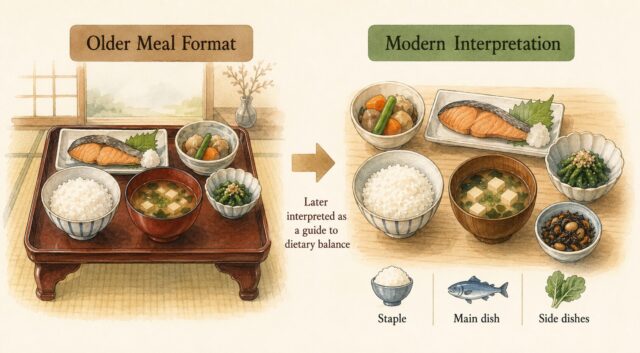
Ichiju sansai did not begin as a modern health program.
It developed from older Japanese dining traditions in which rice, soup, and several dishes were arranged according to a recognizable format. The number, order, and placement of dishes could reflect etiquette, hospitality, and the occasion.
The purpose was not to calculate protein, vitamins, calories, or other nutrients.
Those ideas belong to modern nutritional science.
Ichiju sansai was first a way of composing and serving a meal.
As nutrition science developed in modern Japan, the same structure began to be interpreted in a new way. Rice could be understood as the staple, the main dish as a source of protein, and the smaller dishes as places for vegetables, seaweed, beans, and other ingredients.
This modern interpretation did not create ichiju sansai.
It gave an older meal format a new role as a guide to dietary variety and balance.
Rice Is the Foundation
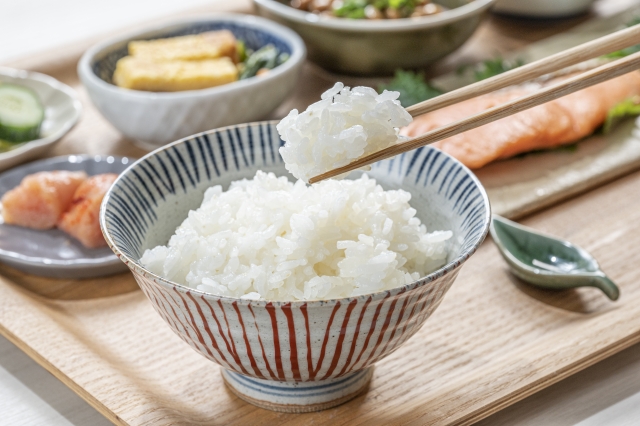
Rice is not counted as one of the three dishes because it forms the base of the meal.
This can seem unusual to readers from cultures where the largest meat or fish dish is treated as the center.
In many Japanese meals, rice provides the stable foundation around which everything else is arranged.
It is mild, soft, and filling.
The other dishes may be salty, savory, sour, sweet, or strongly seasoned. Rice balances those flavors and gives them a place within the meal.
A piece of grilled fish may be quite salty on its own. Pickles may be too intense to eat in large amounts. Simmered vegetables may carry soy sauce, dashi, or sweetness.
With rice, those foods become easier to combine.
This is one reason the side dishes can remain small.
They do not need to provide the whole meal by themselves.
The Role of Soup
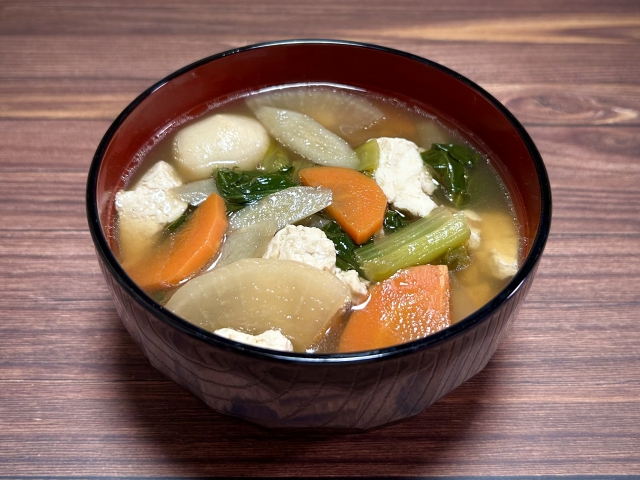
The soup in ichiju sansai is often miso soup, but it does not have to be.
Clear soup, seafood soup, vegetable soup, or another broth may also be served.
Soup adds warmth and moisture.
It provides a pause between bites and helps connect rice with stronger-flavored foods.
A bowl of soup may also contain tofu, wakame, mushrooms, root vegetables, clams, or seasonal ingredients.
This gives it more than one function.
It is both the liquid part of the meal and another place where ingredients can be included.
Soup does not need to be large or complicated.
Its importance comes from how it supports the rest of the table.
What Counts as the Three Dishes?
The three dishes are usually understood as one main dish and two side dishes.
The Main Dish
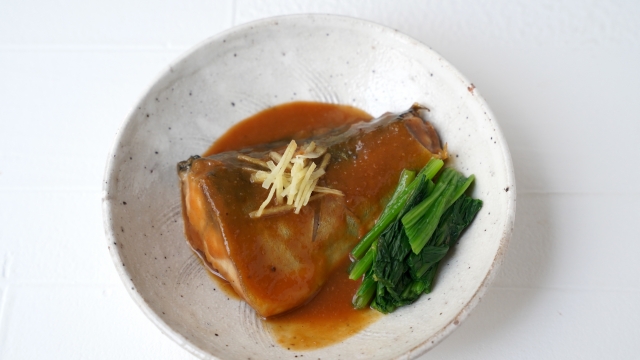
The main dish generally has the strongest presence.
It may be:
- grilled fish
- simmered fish
- chicken
- pork
- tofu
- eggs
- a small meat or vegetable preparation
The main dish often provides protein, richness, and stronger flavor.
However, a Japanese main dish does not always need to be large.
Rice, soup, and side dishes share the work, so the main item can remain relatively modest.
The Side Dishes
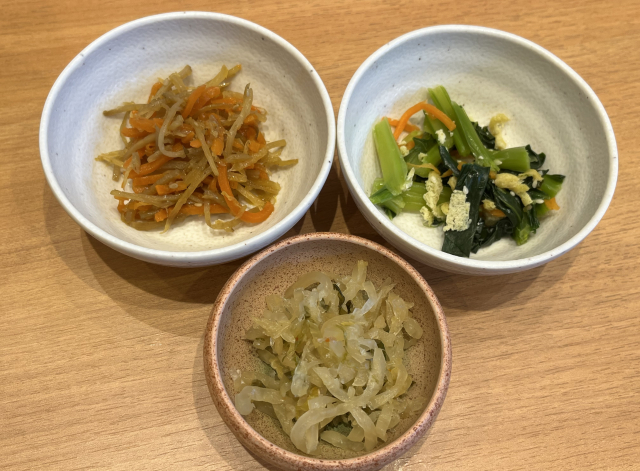
The side dishes may contain:
- vegetables
- seaweed
- mushrooms
- beans
- tofu
- root vegetables
- leafy greens
They may be simmered, boiled, grilled, dressed with sesame, served chilled, or lightly seasoned.
Their purpose is not simply to increase the number of plates.
They introduce contrast.
One dish may be soft, another crisp. One may be warm, another cool. One may be lightly flavored, while another is salty or sour.
The meal feels varied even when every portion is small.
Why the Structure and Separate Dishes Matter
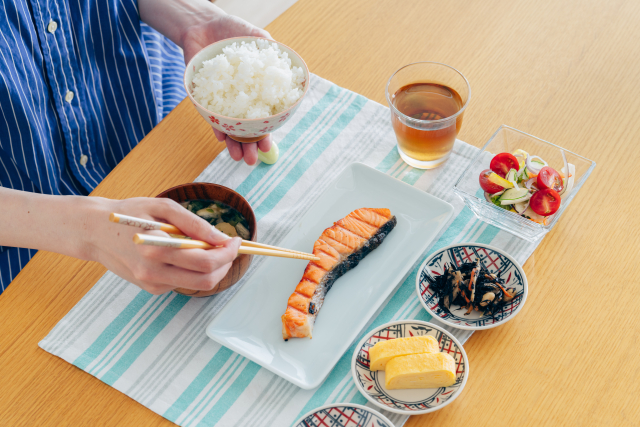
Ichiju sansai gives the meal a clear shape.
Rice provides the staple. Soup adds warmth and moisture. The main dish brings substance and stronger flavor. Side dishes contribute vegetables, different textures, and additional cooking methods.
No single dish has to provide everything.
The separate bowls and plates make these roles visible.
Rice remains plain. Soup remains fluid. The main dish keeps its stronger seasoning. Each side dish retains its own texture, temperature, and aroma.
The diner moves between them.
A bite of rice may be followed by fish, then soup, then vegetables, and then rice again.
The meal is created through combination and sequence rather than by mixing everything together from the beginning.
This structure also creates flexibility.
Fish can be replaced with tofu. One vegetable dish can be exchanged for another. Leftovers can fill one place on the table. Soup ingredients can change with the season.
One dish can be removed or added without changing the basic logic of the meal.
In modern Japan, this format is also used as a guide to dietary variety. It can help people notice whether a meal depends too heavily on one type of food or includes several different ingredients and roles.
This does not mean that ichiju sansai automatically creates a healthy meal.
It means that the structure makes variety and balance easier to see.
Teishoku Shows the Structure Clearly
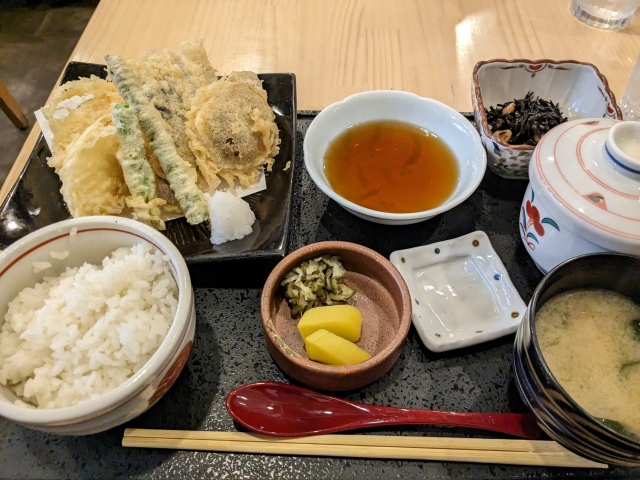
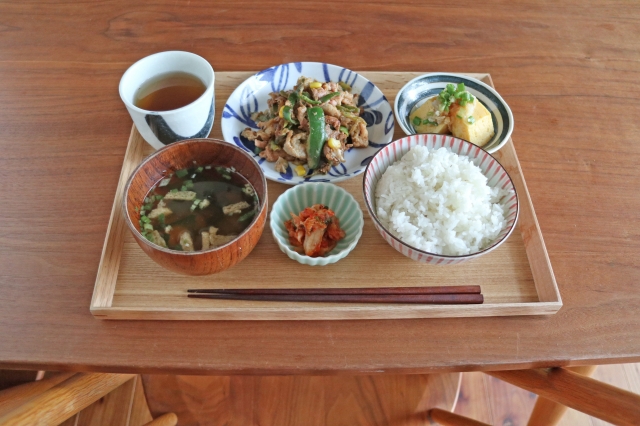
A teishoku, or Japanese set meal, is one of the clearest modern examples of this way of organizing food.
A typical teishoku may include:
- rice
- miso soup
- grilled fish, fried food, or meat
- one or two small side dishes
- pickles
Not every teishoku contains exactly one soup and three dishes.
Some are simpler. Others include more items.
But the underlying logic is often similar.
The customer can immediately see the staple, soup, main dish, and supporting foods.
The featured fish or meat may attract the most attention, but rice, soup, and the smaller dishes make it feel like a complete Japanese meal rather than a single plate of food.
For foreign visitors, teishoku offers a practical way to experience the idea of ichiju sansai without first studying formal dining traditions.
Ichiju Sansai at Home: Ideal and Reality
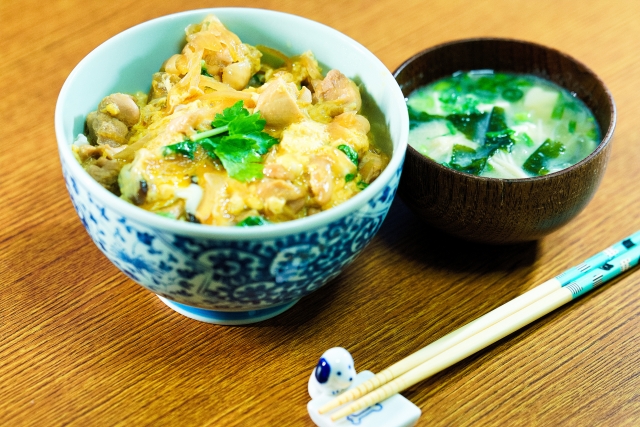
Ichiju sansai is often introduced as the proper structure of a Japanese meal, but many households do not prepare it every day.
Making soup, a main dish, and two separate side dishes requires time, planning, ingredients, cooking, several bowls and plates, and more washing up.
Modern meals are often much simpler.
A weekday dinner may be:
- curry rice
- noodles
- donburi
- rice and one large dish
- rice with miso soup and one side
- supermarket side dishes
- leftovers
- a convenience-store meal
These meals are not failures.
They are ordinary responses to work, school, cost, appetite, and limited time.
Even when a household follows the ichiju sansai pattern, the dishes do not all need to be freshly cooked.
One side dish may come from the previous night. Pickles may come straight from a package. Tofu may be served cold with soy sauce and green onion. The soup may be instant or made with vegetables already in the refrigerator. The main dish may be bought ready-made.
A home version is often assembled from:
- leftovers
- preserved foods
- prepared side dishes
- simple uncooked foods
- dishes made earlier
The structure can still influence the meal without being followed perfectly.
What About Ichiju Issai?
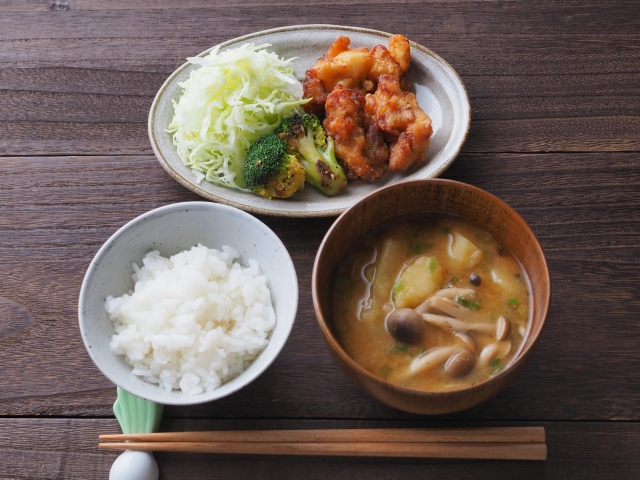
Ichiju issai means “one soup and one dish.”
It is a much simpler meal pattern.
A basic version may include:
- rice
- soup
- one dish
- pickles
This can be enough.
Ichiju issai recognizes that rice and soup already create a foundation. One additional dish can provide vegetables, protein, or stronger flavor without requiring a full spread.
For many people, this is closer to everyday reality.
It also corrects the idea that a Japanese meal must always contain many small dishes.
Ichiju sansai shows the complete model clearly.
Ichiju issai shows how the same logic can be simplified.
Ichiju Sansai at a Ryokan
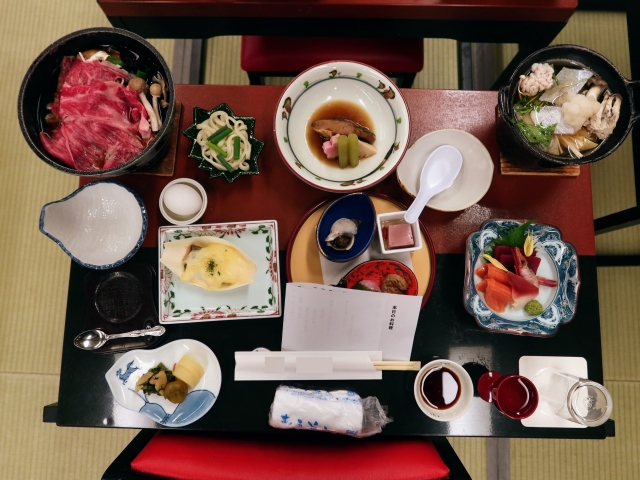
Ryokan meals often present a more elaborate development of the same basic idea.
Rice and soup may be joined by grilled fish, simmered vegetables, tofu, pickles, regional ingredients, and several small preparations.
The number of dishes may go far beyond three.
This means that a ryokan meal is not necessarily a literal example of ichiju sansai.
However, the underlying principle remains visible.
Even when the number of dishes increases, each one still has a purpose. One adds warmth, another texture, another seasonal flavor, and another connection to the region.
The meal is still created through the relationship between several foods rather than through one dominant plate.
In that sense, a ryokan meal can be understood as an expanded version of the same organizing logic.
It is also a hospitality meal designed to express care, season, place, and presentation.
It should not be confused with an ordinary weekday dinner.
Is Ichiju Sansai a Healthy Way to Eat?
Today, ichiju sansai is often presented as a model of balanced eating.
There is some logic behind that idea.
The structure can make room for:
- a staple food
- protein
- vegetables
- seaweed
- mushrooms
- beans
- soup
- several cooking methods
This can encourage variety without requiring detailed nutritional calculations.
However, the format alone does not guarantee health.
Miso soup, pickles, salted fish, soy sauce, and simmered dishes can add considerable salt. Fried foods may also appear. White rice may form a large part of the meal.
Portion size, ingredient choice, and cooking methods still matter.
Ichiju sansai is therefore better understood as a guide than as a guarantee.
It helps people see whether a meal has several roles and types of food, but it does not make every possible combination nutritionally perfect.
Why the Structure Still Matters
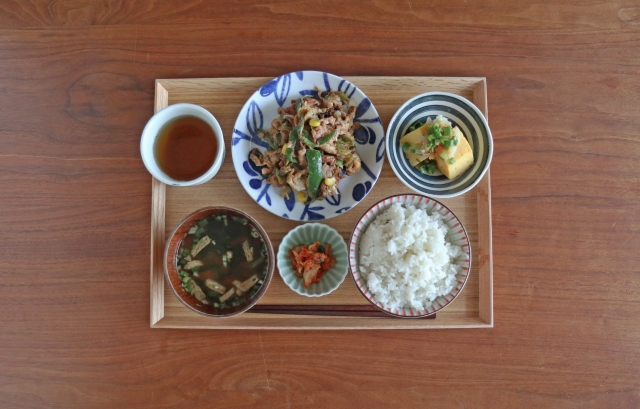
Even when people do not follow ichiju sansai exactly, the model remains useful.
It helps explain why Japanese meals often include:
- plain rice
- soup
- a modest main dish
- several supporting foods
- different textures and temperatures
- separate bowls and plates
It also provides a basic format for planning a meal.
Instead of asking one dish to do everything, the meal can be divided into roles.
A main dish can provide substance. A vegetable side dish can add color and texture. Soup can add warmth. Rice can connect the flavors.
The format gives the cook a starting point.
It also gives the diner a way to understand what is on the table.
What Ichiju Sansai Reveals About Japanese Food Culture
Ichiju sansai reveals a way of thinking about meals through role-sharing.
Rice provides the foundation.
Soup adds warmth and moisture.
The main dish gives the meal strength and stronger flavor.
The side dishes bring vegetables, texture, color, and contrast.
No single dish needs to dominate.
The structure also shows the importance of supporting foods.
A small bowl of simmered vegetables or a few pieces of pickles may seem minor, but they can change how the whole meal feels.
At the same time, the distance between the ideal and everyday reality is also part of the story.
People recognize the model in set meals, traditional dining, school lunches, ryokan meals, and home cooking.
But ordinary meals are often simpler.
Ichiju sansai is therefore both practical and aspirational.
It began as a way of organizing a meal.
Today, it also works as a reference point for variety and balance.
The purpose is not to make every meal perfect.
It is to provide a basic shape that can be followed, simplified, or returned to when everyday eating becomes too unbalanced.
Author’s Note
Ichiju sansai is easy to understand as an ideal.
It looks balanced, orderly, and complete.
The difficult part is actually preparing it.
Making soup, a main dish, and two side dishes takes time. It also creates many bowls and plates to wash. On busy days, that level of effort is not realistic for many households.
That does not make the idea meaningless.
Even a simpler meal can borrow from the same structure.
Rice and miso soup may form the base. One main dish may be enough. A small package of pickles or leftover vegetables can add another role without much work.
People also tend to think more carefully about meal balance as they grow older. When you are young, irregular meals and heavy food may not seem to cause any immediate problem. Later, salt, vegetables, portions, and daily habits can become harder to ignore.
Personally, I think it is better to understand ichiju sansai as a basic pattern rather than a standard that every meal must meet.
It gives us a useful way to see the Japanese table.
But reality is often closer to one soup and one dish—or sometimes just one bowl.
FAQ
What does ichiju sansai mean?
Ichiju sansai means “one soup and three dishes.” It usually describes a meal with rice, one soup, one main dish, and two smaller side dishes.
Is rice included in the three dishes?
No. Rice is generally treated as the staple and foundation of the meal rather than as one of the three dishes.
Are pickles counted as one of the three dishes?
Usually not. Pickles are commonly treated as a separate supporting food.
Was ichiju sansai originally created as a healthy diet?
No. It began as a way of organizing and serving a meal. Its value as a guide to nutritional variety is a modern interpretation.
Do Japanese people eat ichiju sansai every day?
No. It is an ideal meal structure rather than a rule followed at every meal. Many everyday meals are much simpler.
What is the main dish in ichiju sansai?
The main dish, or shusai, often contains fish, meat, tofu, eggs, or another food with a substantial role.
What are the side dishes in ichiju sansai?
The side dishes, or fukusai, often include vegetables, seaweed, beans, mushrooms, tofu, or other small preparations.
What is ichiju issai?
Ichiju issai means “one soup and one dish.” It is a simpler meal structure that may include rice, soup, one dish, and pickles.
Is teishoku the same as ichiju sansai?
Not exactly. A teishoku is a set meal, and not every teishoku contains exactly one soup and three dishes. However, many follow the same basic structure.
Is ichiju sansai always healthy?
No. It can encourage variety, but salt, portion size, ingredients, and cooking methods still affect the nutritional balance.
Where can visitors see this meal structure in Japan?
The pattern is often visible in teishoku set meals, ryokan meals, traditional restaurants, school lunches, and some home-cooked meals.
Why are Japanese meals served in separate dishes?
Separate dishes allow each food to keep its own flavor, texture, temperature, and role. The diner combines them gradually while eating.
Related Reading on YUNOMI
- Japanese Food Culture: How Everyday Ingredients Shape the Japanese Table
- What Is a Japanese Breakfast? How Rice, Miso Soup, and Small Dishes Work Together
- What Is Japanese Rice? Why Short-Grain Rice Matters in Japanese Food Culture
- What Is Miso Soup? Why It Is So Common in Japan
- What Are Japanese Pickles? Why Tsukemono Matter in Everyday Japanese Meals
- What Is Tofu in Japan? Why It Is More Than a Meat Substitute

