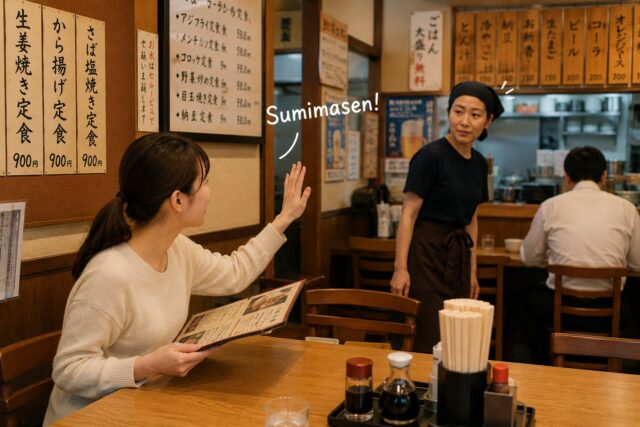
In some countries, customers wait quietly for a server to approach the table, so this can feel unexpectedly direct or even rude at first.
In Japan, however, saying "Sumimasen" is usually considered a smooth and polite way to begin interaction when assistance is needed.
Why Customers Usually Call Staff Themselves
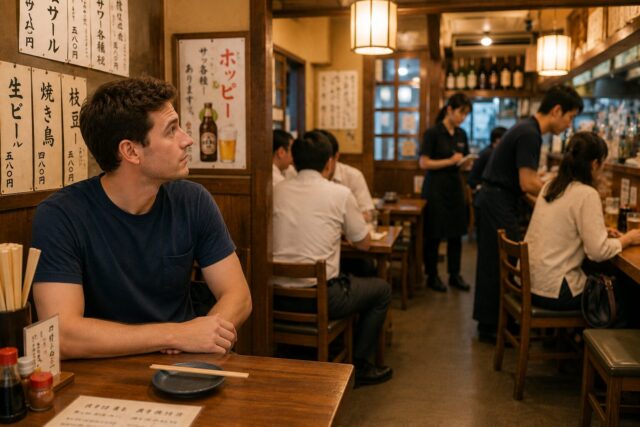
In many Japanese restaurants, customers are generally expected to signal staff themselves rather than waiting for eye contact.
In many Japanese restaurants, staff members do not repeatedly approach the table to ask questions like:
- "How is everything?"
- "Do you need anything else?"
- "Are you still working on that?"
Instead, servers generally try to avoid interrupting the natural flow of the meal unless necessary. Because of this, customers are expected to signal staff themselves when they need something — whether that means ordering additional food, asking for water or tea, requesting the bill, or simply getting assistance.
Rather than waiting for staff to approach automatically, customers actively begin the interaction when the timing feels right. From a Japanese perspective, this system is often considered efficient, smooth, and less disruptive to the dining experience overall.
"Sumimasen" Is Not Just an Apology
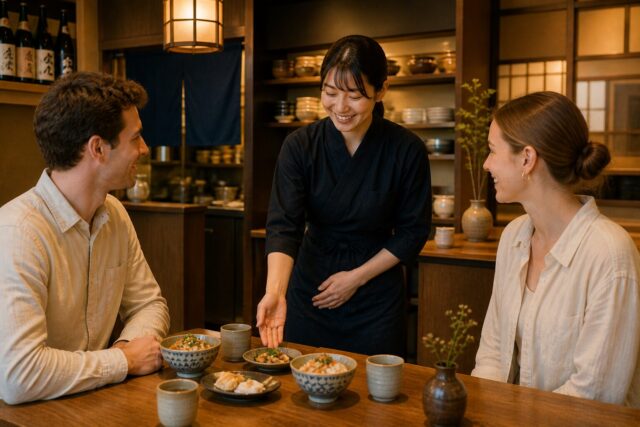
Japanese restaurant service often aims to stay attentive without interrupting the flow of the meal.
One reason this situation can feel confusing to visitors is that "Sumimasen" is difficult to translate directly into English. Although it is often introduced as meaning "sorry" or "excuse me," the word carries a much wider range of meanings depending on the situation.
In restaurants, "Sumimasen" usually means something closer to "Excuse me," "May I ask for your help?" or "Could I get your attention?" Importantly, it does not sound angry or demanding.
Even when spoken loudly enough for staff to hear across the room, the phrase still carries a gentle and non-confrontational tone.
Japanese people also sometimes say "Sumimasen" after receiving service — when staff refill a water glass or bring an additional dish, for example.
In these moments, the phrase carries a meaning closer to "Thank you for the trouble," functioning as a humble and socially considerate expression rather than a direct apology.
Why Waiting for Eye Contact Sometimes Feels Different in Japan
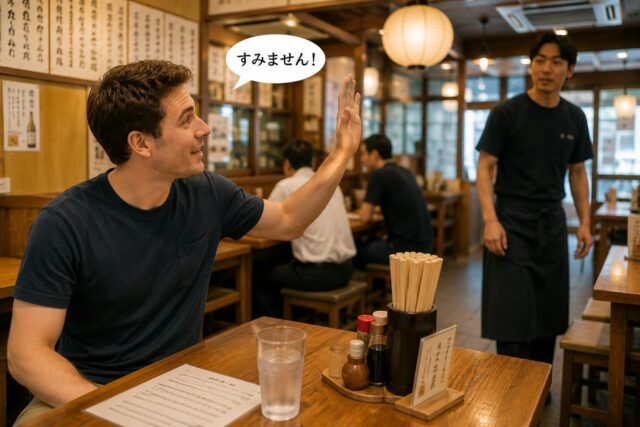
Lightly raising a hand and saying “Sumimasen” is often considered a smooth and polite way to begin interaction.
In many Western restaurants, customers wait to catch their server's eye before asking for something. In Japan, restaurant communication often works a little differently.
Staff members are usually paying close attention to the dining room, but they tend to do so without making customers feel constantly watched or interrupted. Rather than repeatedly approaching the table or maintaining obvious eye contact, staff often wait for customers to signal when they need help.
Because of this, lightly raising a hand and saying "Sumimasen" is often the smoothest and most natural way to begin an interaction. Japanese restaurant service is not built on ignoring customers — it is built on noticing them without intruding on their space.
Japanese Service Often Avoids Interrupting the Meal
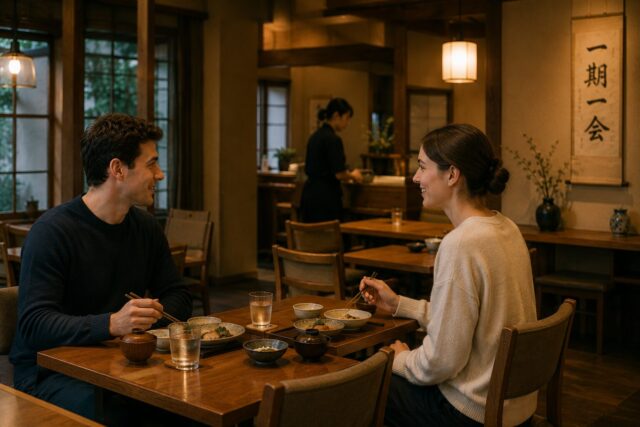
Many Japanese restaurants try to balance attentiveness with a calm and uninterrupted atmosphere.
The use of "Sumimasen" also reflects a broader difference in service culture. In some countries, attentive service means frequent interaction between staff and customers, with servers checking on the table regularly to appear engaged.
In Japan, however, excessive interruption can feel uncomfortable or disruptive. Many restaurants instead aim for a quieter form of hospitality in which staff remain attentive without constantly entering the customer's space.
This creates an interesting balance: staff remain observant, customers control the timing of interaction, and the atmosphere stays calm and uninterrupted.
Within this system, calling out "Sumimasen" becomes a natural communication tool rather than an awkward imposition.
Pro Tip: You Don't Need to Shout
If you feel nervous about calling out "Sumimasen" in a quiet restaurant, you are not alone. In most situations, you do not need to raise your voice across the room.
- Wait until a staff member is nearby.
- Raise your hand slightly.
- Say "Sumimasen" clearly in a calm voice.
In most restaurants, this is more than enough to get staff attention naturally and politely.
Modern Japanese Restaurants Often Use Technology Instead
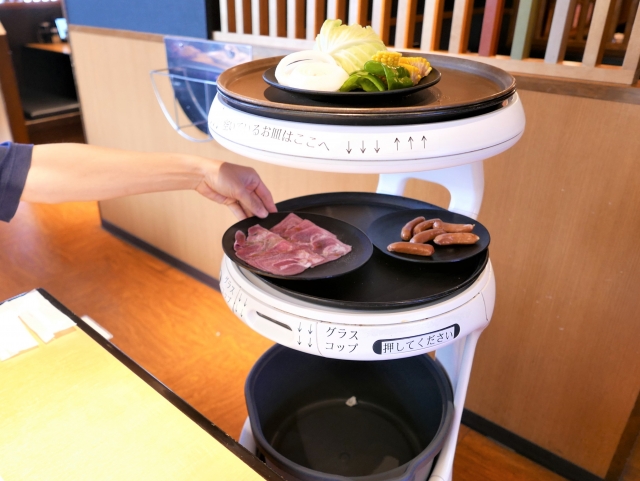
Serving robots have become increasingly common in Japanese restaurants in recent years.
In modern Japan, many restaurants now use technology that reduces the need to call staff directly.
Tablet ordering systems, mobile ordering apps, electronic call buttons, self-checkout counters, and cashless payment have become increasingly common — especially in chain and family restaurants. In some places, even food delivery is partially handled by serving robots.
Because of this, customers today may actually say "Sumimasen" less often than many visitors expect. Many people simply place orders on a tablet, press a call button, or raise a hand lightly when staff pass nearby.
In modern Japanese restaurants, a small gesture is often considered smoother and less disruptive than calling out across the room.
Part of this shift accelerated during and after the COVID-19 pandemic, as many restaurants faced labor shortages, rising operating costs, and growing demand for contactless service. Even as technology becomes more prevalent, however, Japanese restaurants still tend to prioritize smooth, low-pressure communication and a calm dining atmosphere.
"Sumimasen" therefore remains less about loudly demanding attention and more about maintaining a socially considerate way to begin interaction when it is needed.
Quietness and Direct Communication Coexist in Japan
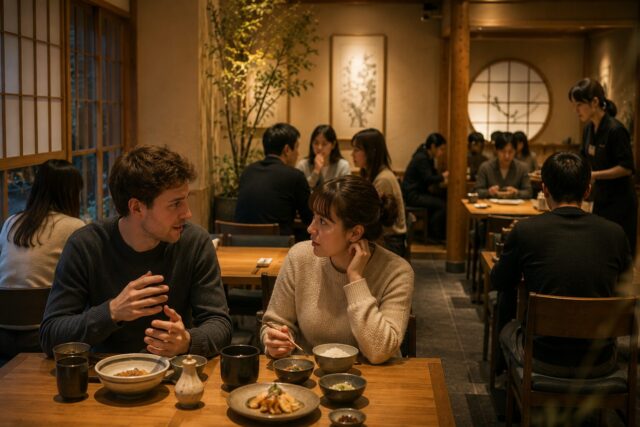
Japanese restaurant communication often stays quiet, brief, and designed not to disturb the atmosphere around other diners.
At first glance, Japanese restaurant culture can seem contradictory. Restaurants often feel quiet and restrained, and customers are generally expected to avoid disturbing the atmosphere. Yet directly signaling staff when needed is completely normal.
The key difference is that this communication is usually designed to stay smooth, brief, and low-pressure rather than emotional or confrontational. Japanese restaurants often try to create a balance where customers feel both cared for and left alone at the same time.
Whether through "Sumimasen," a raised hand, a call button, or a tablet screen, the goal is usually the same: allowing communication to happen smoothly without disturbing the atmosphere around other diners.
Once visitors understand this balance, Japanese restaurant communication often starts to feel less unusual — and more like part of the carefully considered experience of dining in Japan.
FAQ
Is it rude to call out "Sumimasen" in Japanese restaurants?
No. In Japan, this is generally considered a normal and polite way to get the attention of restaurant staff when you need assistance.
Does "Sumimasen" mean "sorry"?
Sometimes, but in restaurants it usually means something closer to "Excuse me" or "Could I get your attention?" It is a flexible expression that carries a polite, socially soft tone.
Why don't Japanese waiters check on customers more often?
Many Japanese restaurants try to avoid interrupting the meal unnecessarily. Customers are generally expected to signal staff themselves when assistance is needed, rather than waiting to be approached.
Can I use "Gomen nasai" instead?
Not usually. "Gomen nasai" is a direct apology meaning "I'm sorry," while "Sumimasen" also functions as "Excuse me" when requesting attention or assistance — making it the more appropriate choice in this context.
Do all Japanese restaurants still use verbal ordering?
No. Many modern restaurants now use tablets, mobile ordering systems, call buttons, and self-checkout systems instead of traditional verbal ordering.
Can foreigners say "Sumimasen" too?
Yes. Using "Sumimasen" in restaurants is completely normal and is often appreciated, as it fits naturally within Japanese communication culture.
Should I shout loudly in a quiet restaurant?
Usually not. In most situations, raising your hand slightly and saying "Sumimasen" clearly in a calm voice is sufficient to get staff attention without disturbing the atmosphere.
Why are serving robots becoming common in Japanese restaurants?
Many restaurants introduced more automation in response to labor shortages, rising operating costs, and growing demand for efficient and contactless service.
Related Reading on YUNOMI
- Japanese Restaurant & Hospitality Culture: Why Dining in Japan Feels So Different
- Why Do Japanese Restaurants Feel So Quiet?
- Why Don’t Japanese Waiters Interrupt Your Meal?
- Why Do Japanese Restaurants Have Call Buttons on the Table?
- Why Do Japanese Restaurants Bring the Bill Before You Ask?

