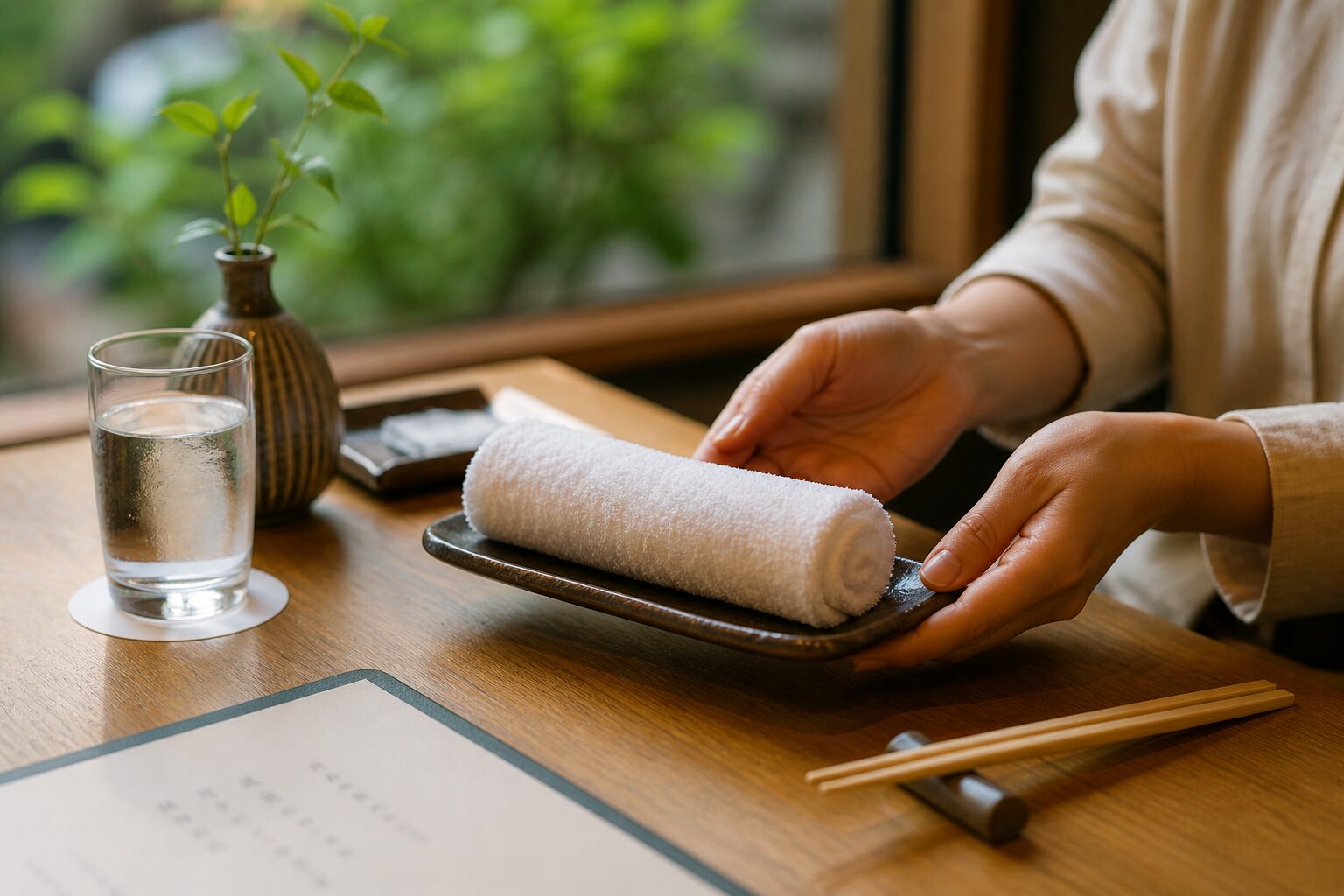
If you visit Japan, you may notice that a small wet towel appears on your table shortly after you sit down. This towel, called an oshibori, is not simply for cleaning your hands — it is part of a broader hospitality system designed to create comfort before the meal even begins.
In Japanese restaurant culture, good service often means anticipating needs before they are expressed. The oshibori reflects this philosophy through a small but meaningful gesture that quietly helps customers relax, refresh themselves, and settle into the dining experience.
More than a cleaning tool, oshibori reflects broader Japanese ideas about anticipatory care, seasonal comfort, smooth service flow, and creating a welcoming atmosphere through small details that require no explanation.
Related Hub: Japanese Restaurant & Hospitality Culture
What Is an Oshibori?
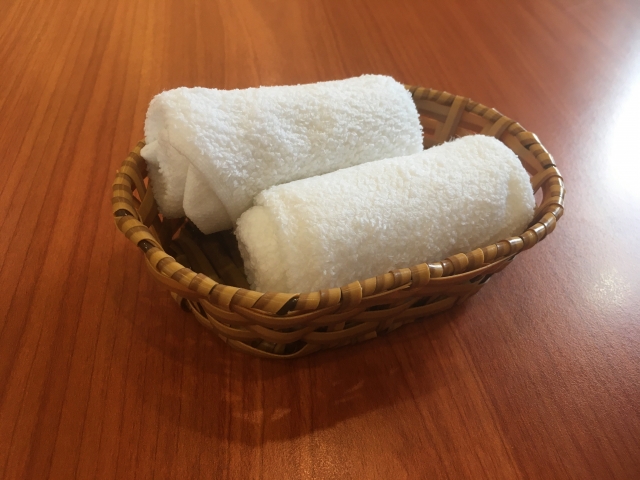
Reusable cloth oshibori are commonly used in restaurants, especially in more traditional or higher-end settings.
An oshibori is a wet towel provided to customers before a meal, primarily used to clean the hands before eating. In casual restaurants it is often disposable, while in higher-end establishments it may be a reusable cloth towel, sometimes presented rolled or folded.
A Small but Essential Item
Although simple, the oshibori plays a meaningful role in preparing customers for the meal. It allows guests to refresh themselves and settle into a more relaxed state before eating — a quiet signal that the experience is about to begin.
Why It Is Given Automatically
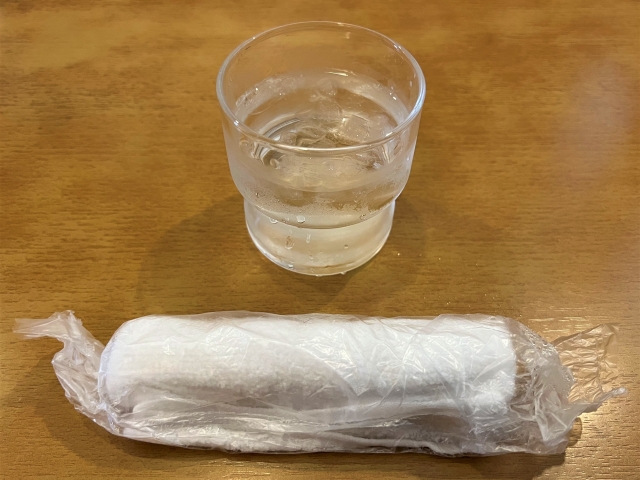
Disposable oshibori are widely used in casual restaurants and are often served together with water.
In Japan, good service often means anticipating what the customer needs before they ask. Providing an oshibori immediately after seating is a clear example of this approach, and one of the most visible expressions of omotenashi — the Japanese philosophy of hospitality that focuses on meeting needs before they are voiced. Rather than reacting to requests, this approach aims to create a seamless experience from the very beginning.
Part of the Service Flow
Oshibori is typically brought alongside water, forming the opening step of the dining experience. This standardized flow helps both customers and staff move smoothly through the meal, creating a sense of rhythm and care from the outset.
More Than Just Cleaning Hands
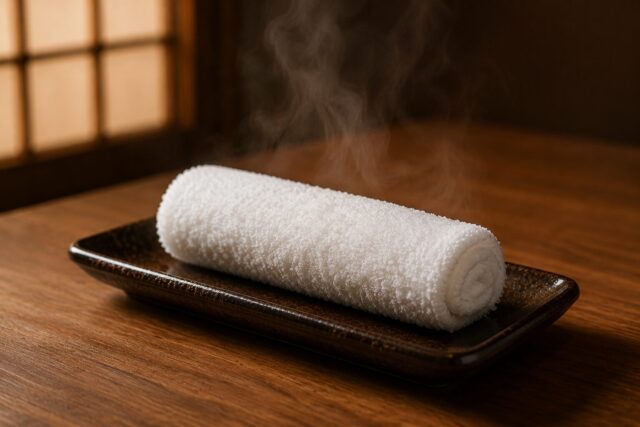
Warm oshibori are often provided in winter to create a comforting experience.
While the practical purpose of an oshibori is hygiene, its role goes beyond that. It creates a sense of attentiveness, signaling that the restaurant is thinking about the customer's comfort. In many places, the temperature of the towel is adjusted by season — warm in winter, cool in summer — adding a thoughtful, seasonal touch.
A warm oshibori on a cold day can feel genuinely comforting, while a cool one in Japan's humid summer heat offers a small but welcome moment of refreshment.
Comfort Through Small Details
These adjustments reflect a broader cultural focus on creating a pleasant and considered experience. Even something as simple as a towel can shape how welcoming a place feels.
Why This Feels Unique to Visitors
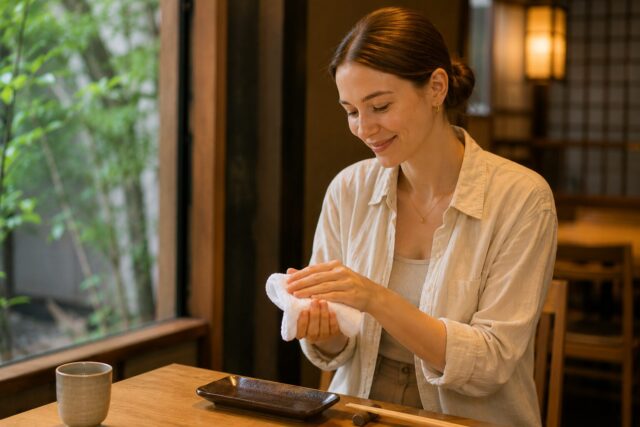
Oshibori helps customers refresh themselves before eating, even for first-time visitors.
For many visitors, receiving a wet towel before a meal comes as a pleasant surprise. In many countries, napkins or hand wipes are not provided automatically — customers either bring their own or request them. This contrast highlights a meaningful difference in how service is structured.
Expectation vs. Request
In Japan, the expectation is that basic needs are already taken care of before the customer thinks to ask. In other systems, the customer is expected to identify and request what they need. Oshibori makes this difference visible and tangible.
Oshibori Etiquette: What to Do and What to Avoid
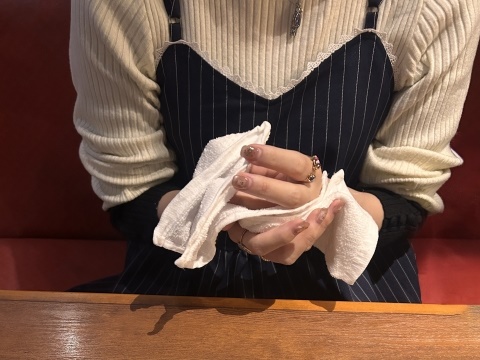
Oshibori is mainly intended for cleaning your hands before a meal.
While oshibori is straightforward to use, a few etiquette points are worth keeping in mind.
What You Should Do
Use it to clean your hands before eating, then fold or place it neatly to one side after use.
What You Should Avoid
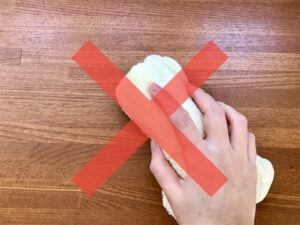
Using an oshibori to wipe the table is generally discouraged in Japanese dining etiquette.
Oshibori is intended for your hands rather than the table. Using it to wipe spills or clean the surface in front of you is generally discouraged. In more formal settings, using it on your face, neck, or mouth during the meal is also usually avoided — paper napkins are more appropriate for that. That said, these are not rigid rules, and in casual environments some flexibility is common and perfectly accepted.
Is There a Cost for Oshibori?

In most restaurants, oshibori is provided as part of the service and does not appear as a separate charge. Like water, it is included in the overall dining experience rather than treated as an individual item. In some establishments — particularly izakaya — a small fixed table charge may apply, but this covers the broader service package rather than the oshibori specifically.
Part of the All-Inclusive Model
This reflects the same structure seen throughout Japanese dining: service elements are bundled into the total experience rather than itemized for the customer to pick and choose from.
Author's Note
As a Japanese person, I never thought much about oshibori until I traveled abroad and realized it was not common everywhere.
When eating foods by hand during my travels, I sometimes found myself wishing for something like an oshibori. Without it, I became more aware of my hands getting sticky or not having an easy way to clean up. It was a small absence, but a noticeable one.
That experience made me realize that oshibori is more than just a towel — it is a small but thoughtful gesture that quietly supports comfort during a meal.
FAQ
What is an oshibori?
An oshibori is a wet towel provided before a meal, primarily used to clean your hands and refresh yourself before eating. It is a standard part of the dining experience in Japan.
Is oshibori free in Japan?
In most restaurants, yes. It is typically included as part of the service and does not appear as a separate charge on the bill.
Can you use it on your face?
In casual settings, some people do, and it is not considered a serious breach of etiquette. In more formal environments, it is generally better to keep it for your hands and use a paper napkin for your face or mouth.
Why is it sometimes hot or cold?
Restaurants adjust the temperature seasonally to enhance comfort — warm in winter and cool in summer. It is a small detail, but one that reflects the broader attention to the customer's experience.
Is oshibori related to tipping?
No. Oshibori is part of the standard service and is not connected to any additional payment. Like water or table settings, it is simply included in the dining experience.
Related Reading on YUNOMI
- Japanese Restaurant & Hospitality Culture: Why Dining in Japan Feels So Different
- Why Is Water Free in Japan?
- Why Do Japanese Restaurants Serve Ice-Cold Water Even in Winter?
- Why Don't Japanese Restaurants Expect Tips?
- Why Don't Japanese Waiters Interrupt Your Meal?
- Why Do Japanese Restaurants Feel So Quiet?

