
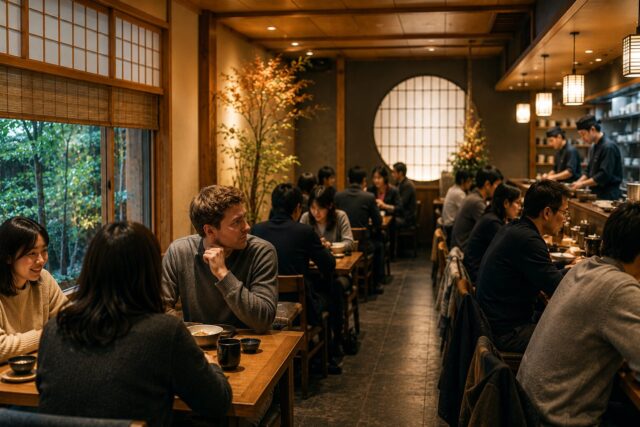
Japanese dining culture tends to prioritize a calm, shared atmosphere rather than filling the space with constant conversation or background noise. In many restaurants, customers naturally adjust their behavior to avoid disturbing those around them — creating an environment that can feel unusually hushed to visitors from louder dining cultures.
This is not because people are not enjoying themselves. In many cases, they are simply enjoying themselves considerately. The atmosphere reflects a broader Japanese social value in which comfort is created collectively — through awareness of others, subtle restraint, and sensitivity to the shared space.
In Japan, quietness is not necessarily associated with awkwardness or unfriendliness. Instead, it is often understood as a form of consideration — one that allows everyone in the shared space to relax comfortably together.
Related Hub: Japanese Restaurant & Hospitality Culture
Silence Is Often Treated as Shared Comfort
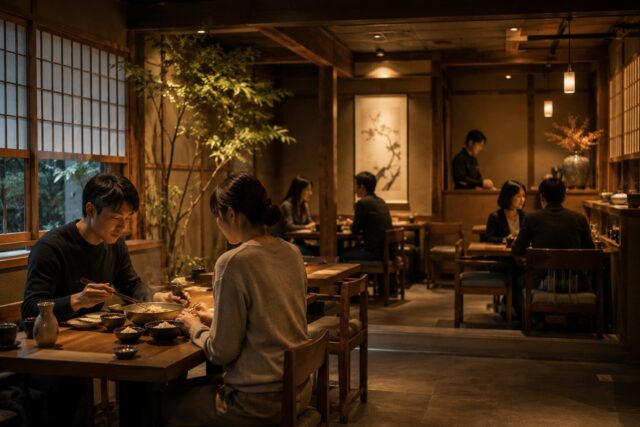
In many Japanese restaurants, a quieter atmosphere is often experienced as comfortable rather than uncomfortable.
In many cultures, silence during a meal can feel uncomfortable or even tense. In Japan, however, a quieter atmosphere is more often experienced as relaxing.
Japanese restaurants frequently aim to create an environment where customers can comfortably focus on their meal, their conversation, or simply the atmosphere itself — without excessive noise competing for attention.
Because of this, many customers naturally lower their voices and avoid drawing attention to themselves.
The goal is usually not complete silence, but a balanced atmosphere in which everyone can share the space comfortably.
People Often Match the Atmosphere Around Them
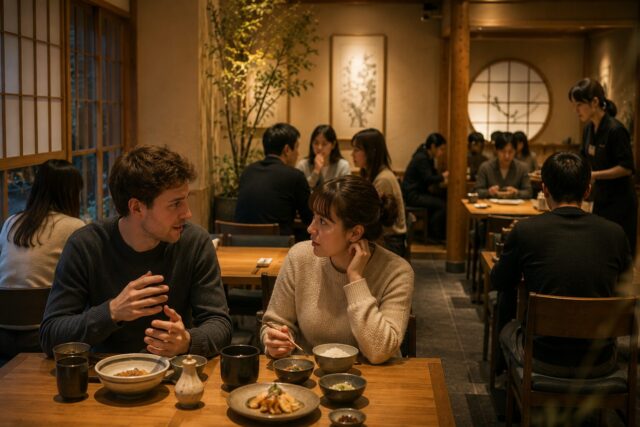
Many people in Japan naturally adjust their speaking volume to match the atmosphere around them.
One reason Japanese restaurants feel quiet is that customers often adjust their volume instinctively to match the environment around them.
If a restaurant is calm, people tend to speak more softly — not because anyone has asked them to, but because it feels like the natural thing to do in that space.
This behavior reflects a broader Japanese social tendency to avoid becoming meiwaku — a source of trouble or disturbance for others.
In shared public spaces, standing out excessively or speaking too loudly can feel inconsiderate, and many people are quietly conscious of this.
The same kind of environment-matching can be seen on trains, in cafés, in elevators, and throughout Japanese public life.
Quietness Does Not Mean Coldness
For some visitors, the subdued atmosphere of Japanese restaurants can initially feel distant or emotionally restrained.
In Japan, however, quietness is generally intended as a form of comfort and respect rather than emotional reserve.
Customers are given space to enjoy their meal without unnecessary interruption, while staff quietly support the experience in the background.
This is closely connected to the broader Japanese hospitality style — attentiveness without intrusion.
In this sense, silence itself becomes part of the service.
Some Sounds Are Accepted More Than Others
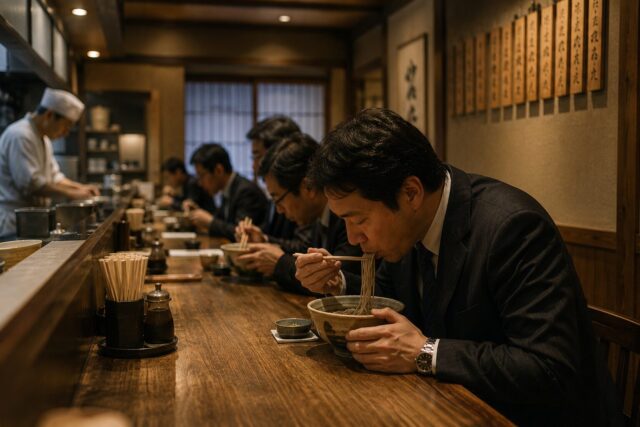
In Japan, noodle slurping is often considered a natural part of the dining experience rather than a disruption.
Interestingly, Japanese restaurant culture does not treat all sounds equally.
Speaking loudly across the room may feel disruptive in a quiet setting, while the sound of slurping noodles is often perfectly accepted — particularly in ramen or soba restaurants.
To many visitors, this contrast can seem surprising at first.
Noodle slurping is traditionally associated with eating naturally and enthusiastically, rather than with disturbing the atmosphere intentionally.
Japanese dining culture is less concerned with eliminating sound entirely and more concerned with whether a sound feels appropriate to the spirit of the place.
The Space Itself Often Encourages Quietness
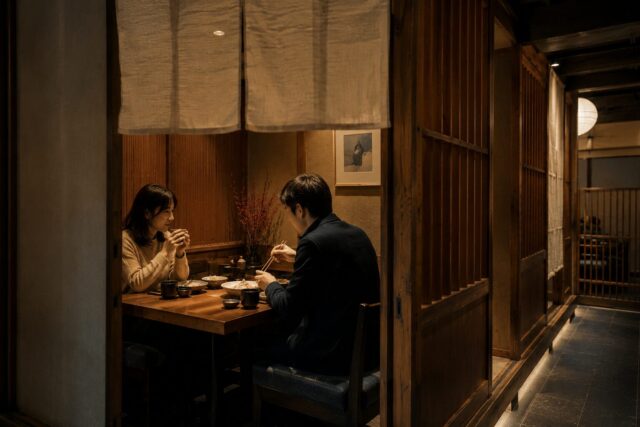
Many Japanese restaurants use space and layout to naturally encourage quieter conversation.
The physical design of Japanese restaurants also shapes the atmosphere.
Many use small seating layouts, wooden dividers, noren curtains, counter seating, or semi-private areas that naturally encourage quieter conversation.
Background music, when present at all, is often very soft — and in smaller local restaurants and cafés, it may be absent entirely.
In these environments, voices carry more easily, and customers often become aware of their own volume without anyone explicitly asking them to be mindful of it.
Not Every Japanese Restaurant Is Quiet
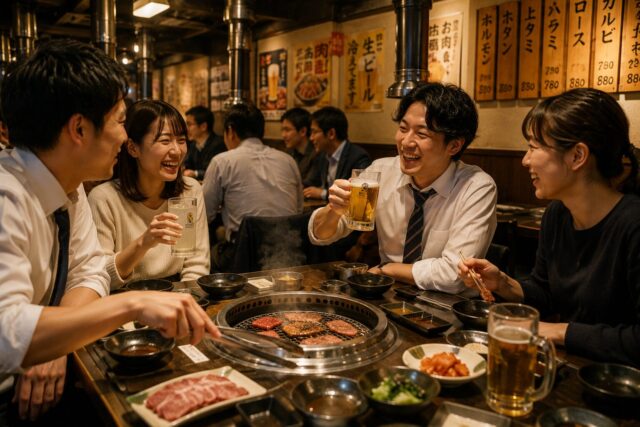
Restaurants such as yakiniku shops and izakaya are often lively and energetic, with the atmosphere becoming part of the experience itself.
Of course, not every restaurant in Japan is calm and subdued.
Izakaya, festival food stalls, yakiniku restaurants, and large group gatherings can be lively, energetic, and quite loud — and that energy is very much part of the experience in those contexts.
Rather than quietness being a fixed cultural rule, many Japanese people simply adjust their behavior to suit the atmosphere of wherever they happen to be.
This flexibility is one reason Japanese restaurant culture can feel both highly considered and surprisingly natural at the same time.
Author's Note
As a Japanese person, I rarely noticed how quiet restaurants in Japan could feel until I traveled abroad.
In some countries, I was initially surprised by how lively restaurants could be — loud laughter, strong reactions at the table, or people speaking on their phones at full volume. It did not necessarily feel rude; it simply felt like a different understanding of what makes a space feel comfortable and social.
In Japan, calmness itself is often treated as part of comfort. Even in busy restaurants, there is often an unspoken understanding that everyone is sharing the atmosphere together, and that this shared space deserves a certain kind of care.
FAQ

Why are Japanese restaurants so quiet?
Many Japanese restaurants feel quiet because both customers and staff tend to avoid disrupting the shared atmosphere. Speaking at a moderate volume and avoiding unnecessary noise is generally considered a form of consideration for others.
Is it rude to speak loudly in Japanese restaurants?
Not always, but in quieter settings speaking very loudly may be seen as inconsiderate to nearby customers. The expectation generally adjusts depending on the type of restaurant and the mood of the space.
Does quietness mean Japanese restaurants are unfriendly?
No. In Japan, quietness is typically associated with comfort, relaxation, and respect for shared space — not with emotional distance or indifference.
Is slurping noodles rude in Japan?
Generally, no. In many noodle restaurants, slurping is considered natural and is sometimes taken as a sign of genuine enjoyment. It is treated quite differently from speaking loudly across the room.
Are all Japanese restaurants quiet?
No. Izakaya, festival food stalls, ramen shops, and group dining situations can often be lively and noisy. The atmosphere varies considerably depending on the type of restaurant and the occasion.
Why do people lower their voices in Japan?
Many people instinctively adjust their behavior in shared public spaces to avoid disturbing others — a tendency that extends beyond restaurants to trains, cafés, and other communal environments.

