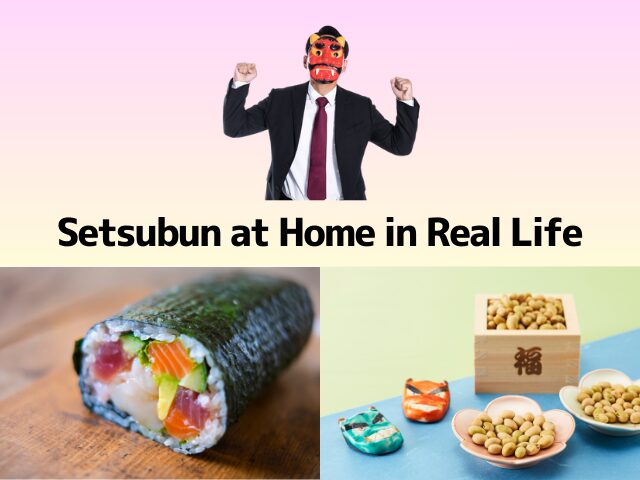
Setsubun looks simple on paper: throw beans to chase away oni, then eat an ehōmaki sushi roll facing the lucky direction.
But the real fun of Setsubun is how “un-serious” it becomes the moment you actually do it at home.
Someone has to be the oni.
Beans go everywhere.
And that “silent, one-go” sushi rule turns into a family challenge that almost nobody follows perfectly.
If you want the basic cultural meaning first, start here:
What Is Setsubun? The Day Japan Throws Beans and Eats a Giant Sushi Roll
Setsubun in Real Life: What It Actually Feels Like
In modern Japan, Setsubun is usually a quick home event.
Not a solemn ritual.
Not a perfect performance.
More like a yearly “reset” that turns into a small comedy scene—especially if there are kids in the house.
Step 1: Most People Don’t Roast Beans at Home
Traditional explanations often talk about roasted soybeans and why they should be roasted.
But in real life, most households simply buy Setsubun beans.
Stores sell ready-to-use packs of roasted soybeans, and many are marketed specifically for Setsubun.
Roasting soybeans at home exists, but it feels like a minority choice now.
For many people, the modern Setsubun starter kit is basically:
- a bag of roasted soybeans (fukumame)
- an oni mask (optional but fun)
- an ehōmaki roll (or two)
Step 2: Someone Becomes the Oni

Dad is forced to play the role of the demon as soon as he gets home
This is where Setsubun turns into a “scene.”
Someone puts on an oni mask.
Someone else throws beans.
If you’ve seen Setsubun photos online, you already know the most common casting:
Dad gets home… and immediately becomes the oni.
It’s not deep philosophy.
It’s everyday family life—one person plays the villain so everyone can laugh while doing the tradition.
Step 3: “Oni wa soto!” / “Fuku wa uchi!” (And the Floor Gets Messy)
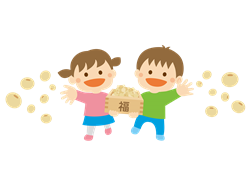
The classic pattern is simple:
- Open a door or window and throw beans outside while saying “Oni wa soto!” (Out with oni!)
- Close it and throw a few beans inside while saying “Fuku wa uchi!” (Fortune in!)
And yes—throwing beans inside your home means your room immediately becomes… bean territory.
Beans bounce.
Beans roll.
Beans hide in corners.
And if you step on one, you don’t just feel it—you kick it, and now it’s in a new location.
(Setsubun is also a yearly reminder that floors are bigger than you think.)
Step 4: Eating “Age Beans” (And Accidentally Eating Too Many)
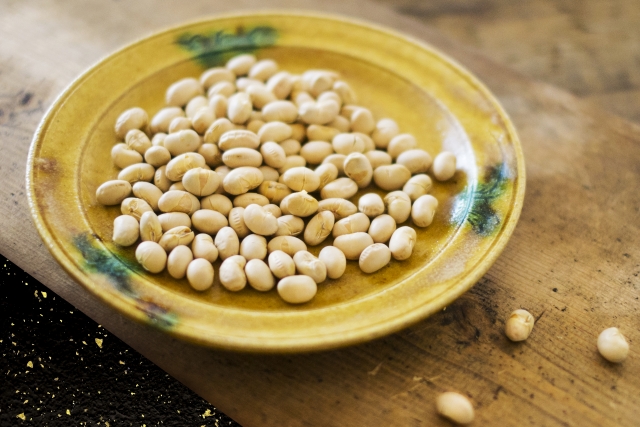
After mamemaki, many families eat roasted soybeans as a health wish for the year ahead.
A common practice is to eat the same number of beans as your age (and sometimes one extra).
But there’s a modern twist.
Setsubun beans are often lightly seasoned—subtly salty, surprisingly snackable.
So what starts as “I’ll eat my age beans” can quietly become:
…Okay, just a few more.
Ehōmaki in Real Life: The “Silent Sushi Challenge”
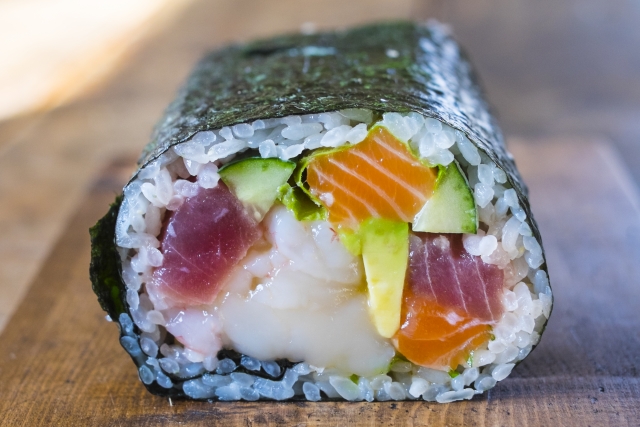
Ehōmaki is the thick sushi roll people eat on Setsubun.
The “proper” rule is often described like this:
Face the lucky direction (ehō).
Don’t talk.
Finish the whole roll.
But at home, Setsubun is rarely that strict.
People laugh.
Kids comment on the fillings.
Someone asks, “Which direction is it again?”
Some families share rolls.
Some buy smaller ones.
Some treat the silence rule as a funny idea instead of a commandment.
That’s the real point: ehōmaki isn’t a test you fail.
It’s a seasonal excuse to do something a little absurd together.
The Supermarket Reality: Ehōmaki Takes Over
If you live in Japan around Setsubun season, you’ll notice something dramatic in stores.
The sushi corner changes.
Normal items shrink.
And suddenly there are mountains of thick sushi rolls—more than you would ever expect.
In supermarkets and convenience stores, Setsubun has become a major seasonal food event.
Ehōmaki sells extremely well, so stores prepare early and push large displays.
For modern Japan, that commercial energy is part of the “real-life” Setsubun atmosphere—whether you love it or find it a little intense.
Why Ehōmaki Feels “New” to Many Japanese People
One reason ehōmaki feels surprisingly modern is that it didn’t become a nationwide “everyone does it” thing until relatively recently.
It’s often described as a Kansai-origin custom, but supermarkets and convenience stores found it incredibly easy to sell as a seasonal event—so it spread fast.
Personally, I didn’t grow up with ehōmaki as a childhood “must-do.”
Seeing it become a national tradition in fairly recent years is part of what makes modern Setsubun feel both cultural and commercial at the same time.
Regional Variations You Might Hear About

Setsubun isn’t identical everywhere.
Depending on the region, you may hear about customs that feel a little different from the “standard” soybeans + ehōmaki version.
Peanuts Instead of Soybeans (Yes, Really)
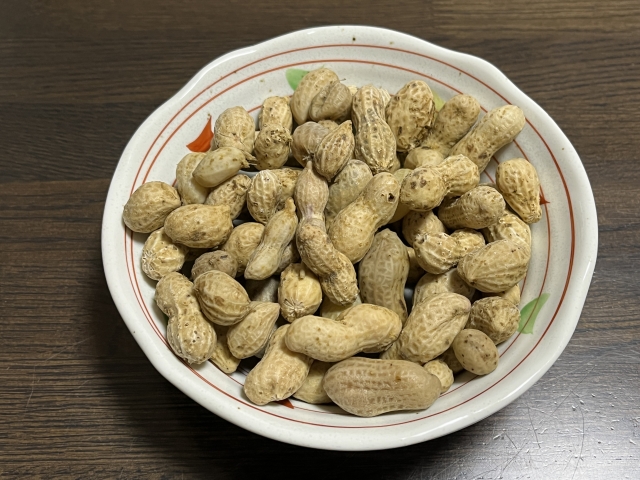
In snowy regions, peanuts are easier to pick up than soybeans—especially after throwing them outside.
One of the most surprising regional variations is using peanuts instead of soybeans.
This is especially common in snowy regions—for example Hokkaidō and parts of Tōhoku (such as Aomori), and it’s also seen in places like Niigata.
If you’re thinking, Why peanuts? the answer is very practical: snow + cleanup.
Roasted soybeans are small.
They bounce, roll into corners, and if you throw them outside in winter, they can disappear into snow.
Peanuts, on the other hand, are bigger and easier to spot.
And because they’re usually still in their shells, they’re often seen as more hygienic if you plan to eat them afterward—even if they landed on the ground or in snow.
There’s also a “local logic” side to it.
In parts of Kagoshima and Miyazaki, peanuts show up in Setsubun bean-throwing too—often explained simply as: peanuts are familiar and locally produced, so they feel like a natural choice.
So if you ever see Setsubun photos where the “beans” look unusually large, there’s a good chance they’re peanuts.
Other Local Foods
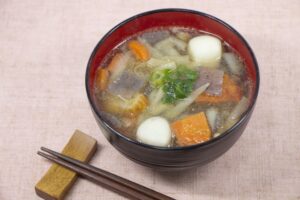
- Kenchinjiru — a traditional vegetable soup eaten as a warming winter food in some areas
- Local “cleansing” customs — some regions have traditions meant to reset the body for the season, with their own local names and styles
Hiiragi Iwashi (Holly + Sardine Head)
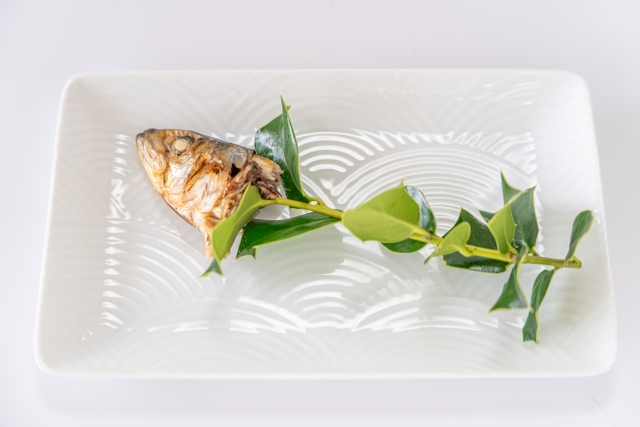
Hiiragi iwashi: a regional Setsubun charm placed near the entrance to keep oni away
You might also hear about hiiragi iwashi, a traditional Setsubun charm most closely associated with western Japan (often linked to the Kansai area).
It’s made by pairing spiky holly leaves with a grilled sardine head.
The idea is simple: the sharp leaves and the strong smell are both believed to discourage oni—meaning “misfortune”—from entering the home.
Because it’s meant to keep oni out, hiiragi iwashi is usually placed outside, most commonly near the front entrance, on Setsubun day.
In some households, the sardine is grilled first, then only the head is used for the charm—while the rest may be eaten as a seasonal food.
Small Tips to Keep Setsubun Fun (Not Stressful)
- Keep the “inside beans” minimal if you don’t want your room covered in soybeans.
- Decide who plays the oni before chaos begins.
- Don’t overthink the rules—Setsubun survives because it’s flexible.
- Plan a quick cleanup (a small broom or vacuum makes the “bean aftermath” disappear fast).
FAQ

Do people really roast beans at home for Setsubun?
Some people do, but many households simply buy ready-to-use roasted soybeans sold for Setsubun season. It’s quick, easy, and widely available in stores.
Is throwing beans inside the house normal?
Yes—many versions include throwing a small amount inside while saying “Fuku wa uchi!” But it can get messy, so some households keep the inside beans minimal or focus more on the “outside” throw.
Do people actually eat the same number of beans as their age?
That’s a common practice, often described as a health wish for the year ahead. In real life, some people follow it, and others treat it casually—especially because the beans are often lightly seasoned and easy to snack on.
Do you really have to eat ehōmaki in silence?
You’ll often hear that rule, but many families aren’t strict about it. People talk, share rolls, or choose smaller sizes. For most households, it’s more of a playful seasonal challenge than a serious rule.
Why does Setsubun feel so “family-focused” in Japan?
Because it’s simple, physical, and easy for children to understand. Someone plays the oni, beans get thrown, everyone laughs, and then you eat seasonal foods together. It’s a tradition designed to work at home.
Final Thoughts
Setsubun is one of those traditions that sounds strange until you see it in real life.
Throw beans at an oni.
Eat a giant sushi roll facing one direction.
It’s weird.
It’s funny.
And that’s exactly why it works.
Setsubun turns seasonal change into something you can actually do at home, once a year, with a little chaos and a lot of laughter.
Author’s Note
In my experience, Setsubun is rarely “perfect.”
Someone gets assigned the oni role (often dad), beans end up everywhere, and the ehōmaki rules become more like a family joke than a strict tradition.
That casual, playful realism is part of what makes seasonal customs feel alive in Japan.

