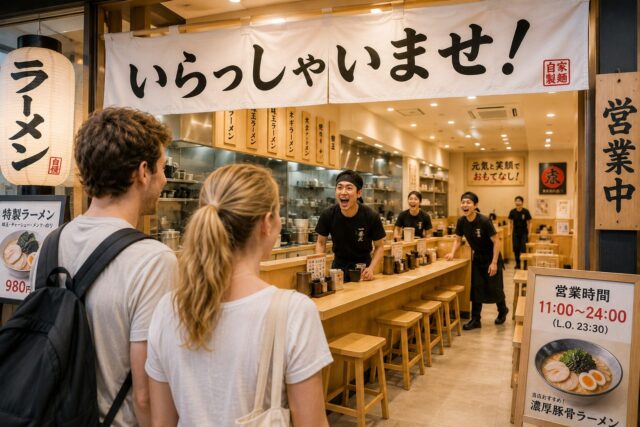
To foreign visitors, the greeting can feel surprisingly energetic, sudden, or even startling at first — especially in busy ramen shops or izakaya where multiple staff members may shout it at the same time.
Many people naturally wonder: "Am I supposed to respond?" "Should I bow back?" or "Why is everyone shouting?"
In reality, "Irasshaimase" is not meant to pressure customers into interaction. It is simply a traditional way of acknowledging a customer's arrival and signaling that they are welcome inside.
Customers are generally not expected to respond verbally, though a small nod or smile is perfectly fine. The style and volume of the greeting vary considerably depending on the type of establishment — from the energetic calls of a ramen shop to the quiet murmur of a high-end restaurant.
What Does "Irasshaimase" Mean?

In quieter cafés, “Irasshaimase” is often a gentle acknowledgment of a customer’s arrival rather than the start of conversation.
"Irasshaimase" is a polite Japanese expression usually translated as "Welcome" or "Welcome in."
The word comes from the honorific verb irassharu, a respectful way of referring to someone coming, going, or being present. In restaurants, stores, cafés, and many other businesses, staff use the phrase to acknowledge customers the moment they enter.
It acts less like a conversation starter and more like a signal that the space is ready to receive and serve them.
You Are Usually Not Expected to Respond

Japanese customers usually do not respond verbally to “Irasshaimase,” and quietly taking a seat is completely normal.
One of the bigger surprises for foreign visitors is that customers are generally not expected to reply to "Irasshaimase." In many countries, a greeting from staff naturally leads into direct interaction — "Hello," "How are you?" or "Table for two?" In Japan, however, "Irasshaimase" often functions as a formal acknowledgment of arrival rather than the opening of a conversation.
Because of this, most Japanese customers simply continue walking inside without responding verbally. Stopping to answer every greeting can even feel slightly awkward in busy restaurants where customers are expected to keep moving smoothly.
A small smile, nod, or quiet "Konnichiwa" is perfectly polite if you want to acknowledge the greeting — but silence is not considered rude in this context.
In many restaurants, staff may immediately follow the greeting with "Nan-mei-sama desu ka?" ("How many people?").
Even if you do not understand the phrase, holding up the appropriate number of fingers is usually enough.
Pro Tip: Don't Panic if Everyone Shouts at Once
In busy restaurants such as ramen shops or izakaya, multiple staff members may call out "Irasshaimase!" simultaneously.
This is not directed at you personally — it functions more like a shared workplace signal announcing that a customer has entered. There is no need to stop, bow deeply, or respond to each staff member individually.
The Greeting Style Changes Depending on the Restaurant
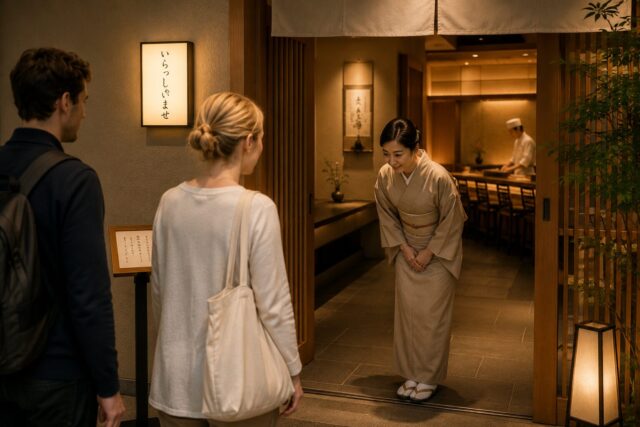
In upscale Japanese restaurants, “Irasshaimase” is often delivered much more softly and formally than in casual ramen shops or izakaya.
Not all Japanese restaurants use "Irasshaimase" in the same way. In ramen shops, izakaya, and casual chain restaurants, the greeting is often loud, synchronized, and full of energy — creating a sense of liveliness and momentum inside the space. In contrast, quieter cafés, traditional restaurants, and luxury establishments greet customers much more softly, sometimes almost inaudibly.
In many ways, the style of "Irasshaimase" reflects the personality of the restaurant itself. An energetic greeting suggests a fast-moving, lively atmosphere; a softer one signals something quieter and more relaxed. The tone of the greeting is often the first cue a customer gets about what kind of dining experience to expect.
"Irasshaimase" Is Part of Japanese Hospitality Culture
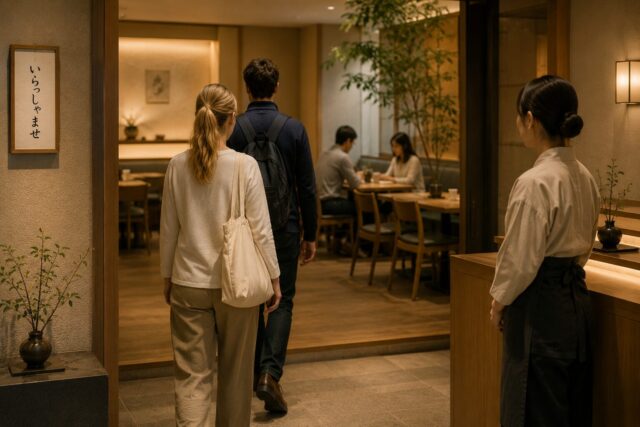
In many Japanese restaurants, hospitality is often expressed through quiet attentiveness rather than constant interaction or conversation.
The greeting is closely connected to broader ideas of hospitality in Japan. Acknowledging customers immediately upon arrival reassures them that staff are aware of their presence and ready to assist. At the same time, the greeting does not demand further interaction — it simply opens the door, so to speak, without pushing customers into conversation.
This reflects a broader Japanese service style that balances attentiveness with respect for personal space. "Irasshaimase" acts as the opening signal of the dining experience — welcoming customers into a shared social space while still leaving them free to settle in at their own pace.
The Greeting Can Feel Surprising Even to Japanese People
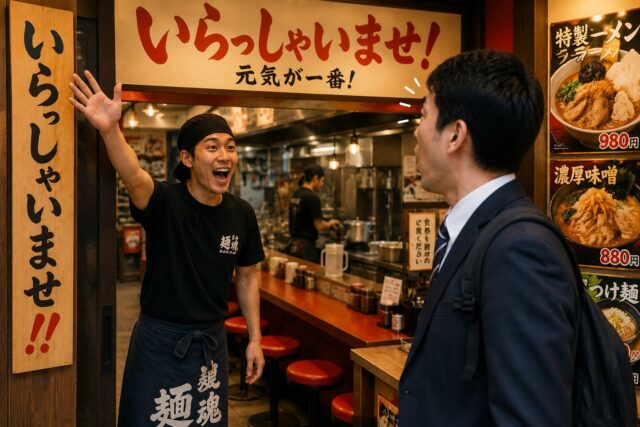
Some Japanese ramen shops intentionally use very loud and spirited greetings as part of their energetic atmosphere — and even Japanese customers sometimes find them surprisingly intense.
Although Japanese people grow up hearing "Irasshaimase" constantly, the greeting can still feel unexpectedly intense in certain restaurants.
Some ramen shops and izakaya use very loud, spirited calls as a deliberate part of the atmosphere.
Others barely register above a murmur. Because the style varies so much from place to place, even Japanese customers occasionally notice just how different the mood can feel when walking through different doors.
More Than a Greeting, It Is a Shared Restaurant Ritual
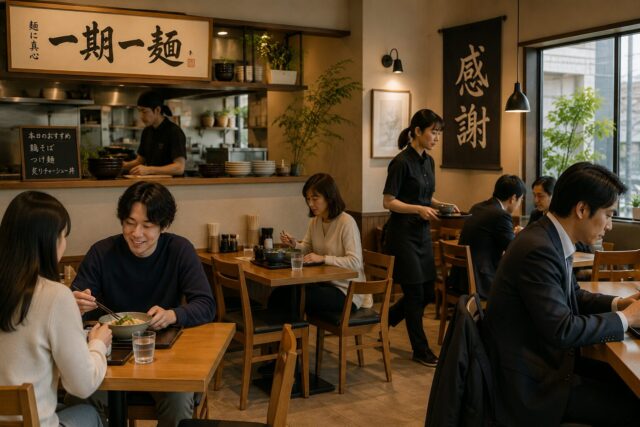
In many Japanese restaurants, greetings and hospitality are woven into the natural rhythm of the space rather than constant direct interaction with customers.
For many visitors, "Irasshaimase" initially feels like a direct social interaction requiring some kind of response. In practice, however, the phrase functions more as a ritualized part of the restaurant environment — something that establishes rhythm, signals readiness, and transitions customers smoothly into the dining experience, rather than something aimed at starting a personal exchange.
Understanding this distinction often makes Japanese restaurant culture feel far less intimidating for first-time visitors. The greeting is not a demand — it is simply the sound of a restaurant coming to life.
FAQ
What does "Irasshaimase" mean?
It is a polite Japanese greeting used in restaurants and shops, usually translated as "Welcome." It acknowledges a customer's arrival and signals that staff are ready to assist.
Do I need to respond to "Irasshaimase"?
No. Customers are generally not expected to reply verbally. A smile or nod is perfectly polite, but staying silent is also completely normal.
Why do Japanese staff shout "Irasshaimase" so loudly?
In some restaurants, particularly ramen shops and izakaya, loud greetings help create an energetic atmosphere and function as an internal signal among staff that a customer has arrived.
Is it rude to ignore "Irasshaimase"?
No. Most Japanese customers do not respond verbally, so silence is completely acceptable.
Do all Japanese restaurants greet customers this way?
No. Greeting styles vary considerably depending on the type of restaurant and the atmosphere it aims to create.
Why do multiple staff members say it at the same time?
In many restaurants, the greeting functions as a shared signal among staff — a way of acknowledging together that a customer has entered the space.
What does "Nan-mei-sama desu ka?" mean?
It means "How many people?" Staff often ask this immediately after greeting customers at the entrance. Holding up the appropriate number of fingers is usually enough if you do not speak Japanese.
Is "Irasshaimase" only used in restaurants?
No. The greeting is commonly heard in shops, cafés, hotels, and many other businesses throughout Japan.
Why does "Irasshaimase" feel unusual to foreigners?
In many countries, greetings naturally lead into direct conversation. In Japan, the phrase often functions as a formal acknowledgment rather than a personal exchange — which can take some getting used to.

